Rafi Industrial Group | Manufacturer and supplier of power cable support equipment


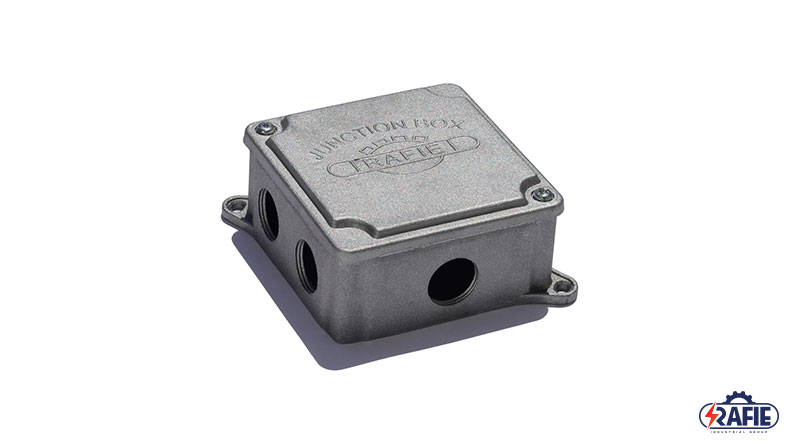
One of the very widely used parts and equipment usually employed abundantly in cabling networks and systems in residential, commercial, and industrial structures is the 20×20 aluminum junction box. This important question may arise in your mind: what exactly is an electrical junction box, and in what cases is it used? To answer this question, we must say that junction boxes are a metal enclosure for protecting electrical cable connections and terminals.
These boxes provide conditions for you to receive one input and have several electrical outputs. The concept of branching precisely conveys this purpose: that you can divide the input electrical current in different directions. Without using the 20×20 aluminum junction box and its other sizes such as the 10×10 aluminum junction box and the 15×15 aluminum junction box, you cannot carry out the branching process in a completely proper manner and with high safety.
Electrical cables require correct management at the connections. For this reason, using practical equipment such as the mentioned parts ensures you have a principled and managed cabling project. If you intend to purchase these junction boxes, it is recommended that you definitely pay attention to the continuation of the article, because we will provide a series of precise information and details about these parts.
The number of cables usable in the 20×20 aluminum junction box depends on several technical factors, including the cable diameter, the type of gland and terminal used, and the arrangement of the cables inside the box. In general, this junction box has a standard semi-industrial size and is suitable for a moderate number of cables.
In light to medium projects: In these projects, with cables of 2.5 to 4 square millimeters, about 8 to 12 cables can be easily installed in this type of junction box.
In larger projects: For cables with larger diameters (for example, 6 to 10 square millimeters), the capacity decreases, and about 4 to 6 cables can be placed inside the 20×20 cm junction box.
A point to note regarding filling this junction box is that the internal space must remain at least 15 to 20 percent empty so that wiring can be carried out easily and no additional pressure is placed on the cables. If you are unsure about the installation and creation of empty space with the appropriate number of cables, you can consult with specialized experts.

All junction boxes made from aluminum alloys as well as steel alloys, if protective coatings are not used, are prone to rust and corrosion. To prevent these parts from being damaged under such conditions, a secondary coating that can completely rustproof them in humid environments is usually applied to the boxes.
For galvanized junction box types, as their name suggests, galvanizing coatings involving molten zinc solutions at high temperatures are used. For the 20×20 aluminum junction box, an electrostatic powder paint is used, which adheres to the junction box with very high adhesion intensity and prevents metal rust in high-humidity environments.
Of course, in terms of protective power, galvanized coatings have a higher advantage over powder paints. For this reason, in environments where the humidity intensity is extremely high and there are very high stresses, using galvanized types will practically be more suitable. The 20×20 aluminum junction box, due to its alloy type, also has good resistance in high-stress environments with humid weather. In industrial sheds and workshops, it is usually preferred to use galvanized types.
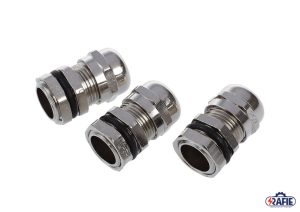
To have a completely stable and safe connection in the 20×20 aluminum junction box, it is necessary to use a series of connecting parts for installation in the junction box. These connecting parts are exactly the glands. Glands have the ability to connect electrical cables directly to various equipment such as various types of electrical panels.
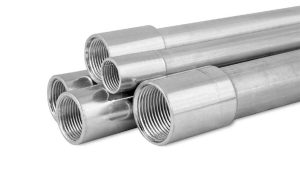
Furthermore, if these cables are placed inside the electrical conduit, it is necessary for the conduits to be placed directly inside the 20×20 aluminum junction box. For conduits as well, a set of several different types of metal glands has been designed that keep the conduit stable inside the junction box.
Using glands has many advantages, including creating conditions for preventing the cables from detaching from the inside of the junction box. The occurrence of any tensile force or impact on cables and conduits that have not used glands will certainly cause them to detach from the 20×20 aluminum junction box and other sizes of this valuable part. Under such conditions, very heavy damage will be inflicted on industrial complexes. For this reason, by using a relatively simple part such as a gland, you can keep your cabling network completely stable over a long period of time.
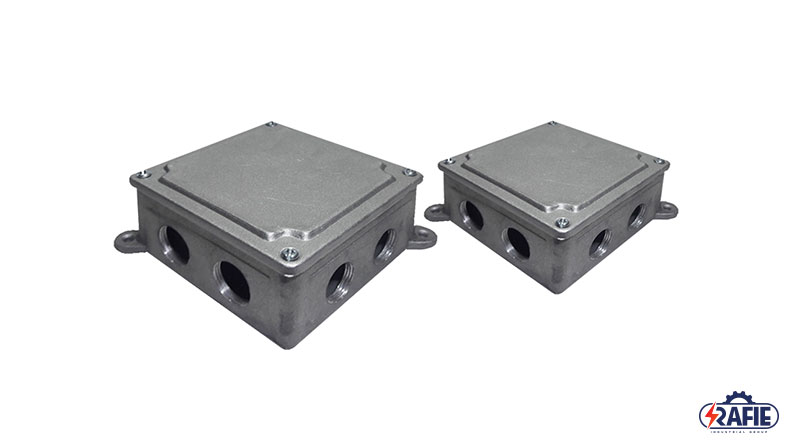
If you are using a junction box in the building cabling system, it is necessary to install it in a specific and safe location. The best place to install the junction box is in the upper part of the wall corners, such that there is a distance of 25 to 40 centimeters between the box and the ceiling.
The cables must be placed inside the box in such a way that after the work is completed, no cable protrudes and the box cover is easily accessible.
Ensure that none of the cables inside the box are uncoated (bare); also, to secure the connections exiting the box, it is necessary to use sockets.
Before starting work and activity on the box, it is necessary to completely turn off the electricity. Some people do this without cutting off the electricity, which is a very dangerous act.
Using a punch, create a hole to provide a way for the wire to enter the box. Also, use a cable clamp to protect the wire coil placed inside the junction box.
If the wires or cables inside the box become tangled, before connecting the wire nut, connect the related wires together using needle-nose pliers.
In industrial buildings and environments, the best way to protect equipment controlled by electronic circuits is to use a junction box, because there is a possibility of damage to electronic boards and components due to proximity to moisture, chemicals, dust, etc.
Using a junction box to house cables and electronic circuits not only protects them but also makes the cabling system appear organized and orderly.
Given that sometimes the number of input and output wires increases, the possibility of error in connecting the related wires arises. In addition, stripping wires and using electrical tape to connect them to each other increases the probability of short circuits. For this reason, using a junction box and placing it in a safe location provides access to the wires while also protecting the terminals well.
Easy access: By installing the 20×20 aluminum junction box, you will have easy access to branches and cables and will be able to use switches and other related components in the least amount of time.
High resistance: Since the aluminum domestic electrical junction box is highly resistant to impact, pressure, and other destructive effects, it will be a suitable place for housing and protecting electrical cables.
Visibility of cable locations: Using a junction box provides you with the ability to easily see the location of splices and cable placements; in this case, to make necessary changes, you will not need to search for the cable locations and will save a lot of time.
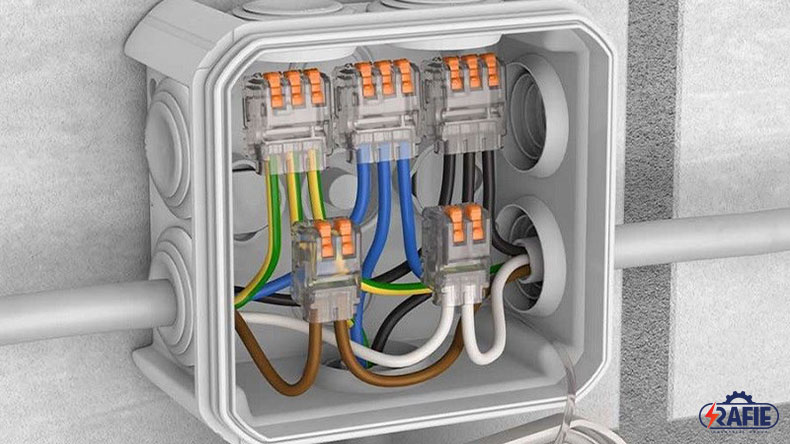
Given that numerous manufacturers are active in the field of manufacturing junction boxes, they offer this product at varying prices and quality. Since the resistance and quality of the junction box will play an important role in its performance, we recommend that instead of buying a cheap and low-quality junction box, you obtain this product from Rafi at a reasonable price and excellent quality. Rafi Industrial Group, with direct production and supply, offers its products at a more affordable price than other stores. To view the price of the 20×20 aluminum junction box and other products, visit the Rafi website.
An aluminum junction box can be used in high-risk work environments with a high hazard factor when it is completely explosion-proof in terms of structural features. Whether an aluminum junction box is explosion-proof is among the very common questions raised by most customers. What exactly is this element, and what advantages does it have for junction boxes?
To explain this question, let us present a completely clear and vivid example. As you know, cable connection points are among the most vulnerable areas in a cabling network. Any contact of external elements such as fluids, moist dust, and even small creatures, and cases of this sort that can cause an electrical discharge or spark at the connection points can lead to devastating explosions in high-risk work environments.
Imagine in a work environment dealing with flammable materials such as gasoline and gas, if the smallest spark occurs inside these junction boxes or in the input and output area, an explosion will practically be certain. Therefore, the design type of the junction boxes is such that the connection points are completely separated from external elements. Consequently, no damaging factor can threaten the connection points. This matter precisely conveys the concept of an electrical junction box being explosion-proof.
Dear customers can purchase various sizes of round aluminum junction boxes and square and rectangular geometric shapes of the highest quality grade from Rafi Industrial Group. In terms of manufacturing material, they are generally available in galvanized as well as aluminum types. To receive more precise information about these junction boxes as well as their price, please contact the experts at this center.
To receive free consultation, please fill out the form below. Rafi Industrial Group consultants will contact you as soon as possible.
To receive free consultation, please fill out the form below. Rafi Industrial Group consultants will contact you as soon as possible.