Rafi Industrial Group | Manufacturer and supplier of power cable support equipment


Electrical steel conduits are produced in branch lengths, and in order to create various angles from them, it is necessary to use suitable elbows. The pull elbow, as one of the best electrical conduit fittings that provides the ability to observe wires and cables through a separate cover, can supply the required angle and curve. Unlike the pull tee, this part only serves the function of angling electrical conduits and will not create branching. This product, alongside other conduit body fittings such as clevis hangers, Spit clamps, and C-channel rails, can provide the safety of the power distribution system.
Given that steel conduits can provide ideal physical protection for electrical cables and wires, we must be able to use these parts to create even the most complex networks. When a cable is routed in an industrial environment, it certainly needs correct direction changes and path routing.
More precisely, these cables are not always on a straight path; rather, they may change direction upwards, left, right, or at an angle. Due to the straight structure of conduits, various fittings such as pull elbows, pull tees, and pull cross fittings are placed between these conduits so that, at the very least, an angle can be created in the path without damaging the cables. These features also apply to pull elbows.
Such fittings also exist for other cable support components such as cable trays and cable ladders. So it is quite clear how vital their presence is. Currently, in a cabling network, the simplest connecting part that can create a 90-degree direction change is the pull elbow. Electrical cables have a relatively higher thickness, so they must create such an angle in their path while preserving their structure. For this reason, the pull elbow was designed and manufactured to complete a standard cabling installation.
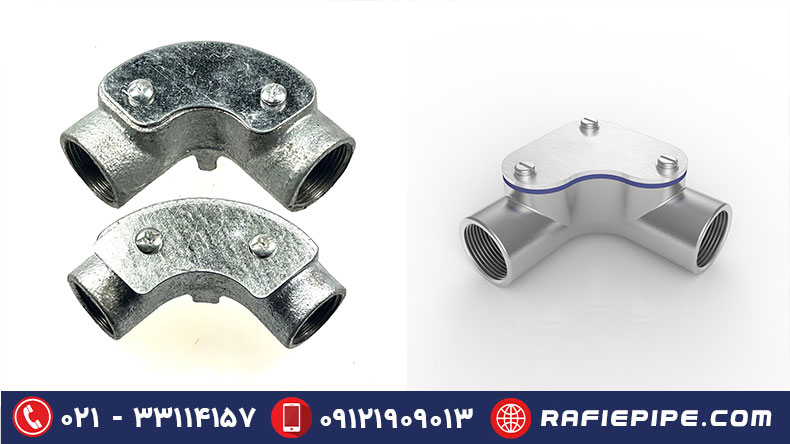
The presence of a separate cover on the pull elbow plays a key role in easier maintenance and safe transmission of wires and cables. Furthermore, the existence of this cover also simplifies possible repairs of wires and cables. Below, we examine in more detail the reasons for having this cover on the elbow:
Access without the need to cut the conduit: The separate cover on the elbow allows access inside without the need to cut or completely open the conduit. In this case, the ability to observe the passing wires and cables is also provided.
Easier troubleshooting and repairs: Many disconnections and damages to electrical cables and wires occur in elbow areas. With the pull elbow, troubleshooting and repairs are made much simpler, and the exact location of the damage can be identified without the need to open the entire fittings and electrical conduits.
Protection of cables: The presence of a dedicated cover that can be tightened onto the elbow protects the cables against dust, moisture, and small animals.
Easy opening and closing capability: The separate covers on these elbows can be opened and closed several times without causing serious damage to the conduit structure.
Reduced maintenance costs: Easy access to the inside of the conduit with the presence of the pull elbow reduces maintenance time and costs for specialists’ repairs.
Ability to add wires and cables: If there is a need to add wires and cables to complete the electrical wiring, this can be done through the separate cover on the pull elbow, without the need to open the conduit and its complete fittings.
When using elbows in electrical conduit installation, no point is more important than the compatibility of the elbow diameter with the electrical conduits used. Manufacturers of these elbows also produce them in such a way that they match the standard size of electrical conduits and tighten in place after installation. The most common sizes of pull elbows include:
These are the standard dimensions of pull elbows that are compatible with electrical conduits; however, given that it is possible to produce electrical conduits with diameters larger than these dimensions, it is sometimes necessary for pull elbows to also be produced in larger dimensions. Fortunately, manufacturing companies, while maintaining standards, have the capability to produce these elbows in larger dimensions. To place an order for these products with custom dimensions, simply contact Rafi Industrial Group.

If you look closely at the image of the pull elbow, you will observe that these fittings are threaded. Unlike some other pipe connecting parts in fluid transmission projects, where connections are used in a welded manner, in relation to the pull elbow for steel electrical conduits, these connections are threaded or screw-type.
Numerous advantages can be considered for this type of connection, the most important of which is quick operation in opening and closing. Of course, according to engineering standards, you must definitely use threaded conduits and fittings for supporting various types of electrical cables, as this matter is defined as a general rule for such conduit networks.
On the pull elbow connecting parts, there is a separate cover that you can install onto the main body of the elbows using two screws. An important point in the design of pull elbows is that you will easily have the ability to manage the cable connections inside the part. In fact, electrical cables are usually joined together to continue along various routes.
These elbows are exactly the parts that can make the cabling process easy and simple for you. Given that the covers are installed on the main body in a completely secure manner and without detaching, damaging environmental elements cannot come into contact with the cable connection point. Furthermore, troubleshooting structural defects along the cabling route can be easily carried out through these covers.

Since metal alloys, especially steel and other iron derivatives, are prone to rusting, at the end of the part design process, it is always necessary to use a separate coating to strengthen them against chemical processes. One of these measures is the use of molten zinc coating on the parts. This process is known as hot-dip galvanization, which ensures that parts made of steel alloys or high-carbon iron do not undergo discoloration, oxidation, or corrosion in environments with high humidity.
This is considered a unique advantage in itself, because both the service life of the pull elbow and other metal parts used in the conduit network increases, and your costs related to repair, maintenance, and structural correction of these parts in the network are significantly reduced. Of course, there are various processes for rustproofing metals, including the use of epoxy paint coatings or cold galvanization. However, currently, the use of molten zinc in the hot-dip galvanization process is among the best strengthening methods.
Dear customers can purchase the most diverse electrical conduit parts and fittings with the highest manufacturing quality in various sizes, and most importantly at an affordable price, from Rafi Industrial Group. You can contact our experts to receive supplementary information regarding any of the products as well as to obtain specialized consultation for purchasing.
A pull elbow is a conduit fitting used to change the direction of cables and electrical wires within electrical conduit systems. This part has a cover for easier access to cables and performing repairs.
Changing the direction of cables in electrical conduit systems.
Protecting cables at various angles.
Providing easy access for repairs and maintenance.
First, determine the conduit route.
Place the pull elbow in the desired location.
Connect the electrical conduits to both sides of the elbow.
Pass the cables through the elbow and close the cover.
Pull elbows are usually made of PVC, metal, or durable plastic to be resistant to impact and corrosion.
The sizes and dimensions of pull elbows are diverse depending on various needs and existing standards, and they can be produced in different sizes from 20 millimeters to 110 millimeters.
Depending on the material of construction and environmental conditions, some pull elbows can also be used in outdoor environments. However, it is better to use the UV and moisture resistant type.
Many pull elbows have waterproof features, but it is better to check the manufacturer’s specifications to ensure their waterproof quality.
Easy access for repair and maintenance.
Better protection of cables at various angles.
Easier installation and connection.
Pay attention to the size and diameter of the electrical conduits.
Consider the environmental conditions of the installation location (indoor or outdoor).
Consider the load and pressure applied to the conduits.
To find reputable brands, you can refer to reputable manufacturers of electrical supplies and conduit fittings and review customer and expert feedback. If you wish, you can contact the experts at Rafi Industrial Group for purchase consultation and pricing of various types of electrical conduit pull elbows.
To receive free consultation, please fill out the form below. Rafi Industrial Group consultants will contact you as soon as possible.
To receive free consultation, please fill out the form below. Rafi Industrial Group consultants will contact you as soon as possible.