Rafi Industrial Group | Manufacturer and supplier of power cable support equipment


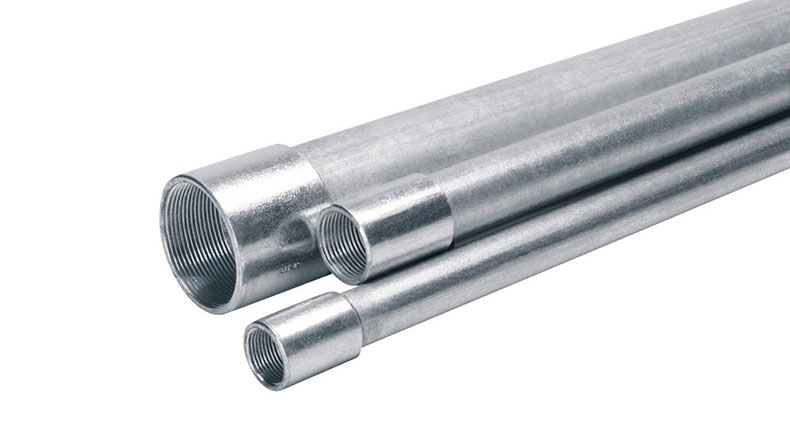
Contractors and engineers seeking highly resistant conduits in the toughest weather, climatic, and moisture conditions can choose hot-dip galvanized steel conduits. This type of electrical steel conduit, with its very thick zinc coating, has extremely high endurance against moisture, corrosive and damaging factors, and can maintain its performance for several years with its resistant and maximum coating, without the need for complex maintenance. The production process of this type of conduit must be carried out with high sensitivity so that the final product has the expected characteristics; therefore, be sure to obtain this conduit from reputable manufacturers.
Hot-dip galvanized steel conduit is the same steel conduits usable in various projects, with the difference that a specific chemical and thermal process has applied a thick layer of molten zinc onto them. The black steel conduit, after complete degreasing and acid washing, is immersed in a molten zinc bath at a temperature of about 450 degrees Celsius.
During this process, a layer of molten zinc metal is deposited on the conduit and increases its resistance to corrosion, moisture, and environmental factors. Hot-dip galvanized conduit, compared to cold galvanized conduits, has higher resistance to moisture and potential damage and can maintain its performance in the long term.
The special production process and having a thick zinc coating on these conduits have greatly increased their advantages. Among the most important key advantages of these conduits are the following:
Unmatched corrosion resistance: The hot-dip galvanizing process creates a strong protective zinc layer on the steel, which provides excellent resistance to corrosion caused by chemicals and oxygen.
High durability and mechanical strength: Steel itself is a resistant material, and the galvanizing process increases this resistance by creating a hard and integrated coating, even against abrasion and physical impacts.
Fire protection: Galvanized conduit shows higher resistance to heat and fire compared to many plastic materials. This characteristic can play an important role in preventing the spread of fire due to short circuits or other incidents.
Easy installation and execution: Despite their high strength, hot-dip galvanized conduits are relatively lightweight and easily cut, bent, and installed. Their connections are also usually made by threading or couplings, which speeds up the installation process.
Cost-effective in the long term: Although the initial cost of galvanized conduits may be slightly higher than other electrical conduits, their extraordinary durability, lower need for repair and maintenance, and much longer service life make them a more economical option in the long run.
Although hot-dip galvanized conduit has a much higher quality compared to light galvanized conduit, if you purchase it without paying attention to a series of points, you may encounter problems during installation and execution.
Thickness of the galvanized coating: The most important factor in the quality of galvanized conduit is the thickness of its zinc coating. The thicker this coating, the greater the corrosion resistance will be.
Appropriate diameter: The diameter of hot-dip galvanized conduits must be coordinated with the number and diameter of the wires that are to pass through them, so as to provide the possibility of safe, pressure-free passage of cables.
Coating uniformity: The galvanized coating must be uniform and free of holes and cracks. Non-uniformity in the coating can be a weak point for the start of corrosion.
Type and quality of base steel: The quality of the steel used in the manufacture of the conduit is also important. Conduits made of high-quality steel will have more flexibility and strength.
Reputable brand and supplier: Purchasing from well-known brands and reputable suppliers with a good track record in providing quality products minimizes the risk of buying substandard goods.
Hot-dip galvanized conduits, due to their unique features, are used in a wide range of electrical industry projects, the most important of which are:
Protection of electrical cables in outdoor spaces: This conduit can be used in telecommunication towers, electrical substations, and power transmission routes that are exposed to severe weather conditions.
Electrical conduit systems in factories and industrial environments: For protecting sensitive cables against chemicals, high humidity, and physical damage, this conduit, with its excellent resistance, is the best choice.
Tunnels and underground spaces: For the safe routing of cables in humid and corrosion-prone environments, the use of hot-dip galvanized conduits is recommended.
Road and highway lighting systems: These conduits can be used with extraordinary efficiency as poles and protectors for lighting cables.
Marine and coastal facilities: In highly corrosive saltwater environments, the use of this galvanized conduit with a very thick zinc coating is recommended.

The thickness of the zinc coating in the hot-dip galvanizing process is one of the most important factors in determining the service life and corrosion resistance of the conduit. This thickness directly depends on the production standards and the type of application of the conduit. Typically, the zinc coating thickness on hot-dip galvanized conduits for general and electrical wiring applications falls within the following ranges:
| Outer diameter of the conduit | Minimum zinc coating thickness (grams per square meter) | Minimum zinc coating thickness (micrometers) |
| Less than 2 inches | 610 | 85 |
| 2 to 4 inches | 760 | 107 |
| Larger than 4 inches | 915 | 128 |
One of the important matters asked by customers when purchasing hot-dip galvanized conduit is how long the service life of these conduits is and for how long they can be used. The service life of hot-dip galvanized conduit, despite the very high coating quality, is influenced by various factors, the most important of which is the environmental conditions. A conduit produced with galvanized coating usually maintains its useful life for at least 15 years. If the conditions for its maintenance are ideal, it can have a service life of up to 30 years.
Hot-dip galvanized conduits, due to having an external zinc layer, can create a coating resistant to moisture. Therefore, even if they are placed in open environments and directly exposed to specific weather conditions, there is no concern about their deterioration. However, the more the surface of the conduits is exposed to moisture, the more their service life decreases.
To select an electrical conduit, several factors must definitely be considered in order to benefit from the safety, correct performance, and efficiency of these conduits in the best possible way. If you need to select the appropriate size of hot-dip galvanized conduit, which is determined based on its diameter, it is better to pay attention to the following points:
Number of cables: The number of cables is the most important factor in determining the size of the hot-dip galvanized electrical conduit. The greater the number of cables that need to pass through these conduits, the larger the conduit diameter must naturally be.
Type and diameter of cables: Among other most important criteria for selecting hot-dip galvanized conduit is the diameter of the cables. The larger the diameter of the cables, the thicker conduits must naturally be used. This prevents additional pressure from being exerted on the cables.
Adequate ventilation space: Some cables generate a lot of heat. Sufficient ventilation space must be considered for the conduits so that, in addition to providing the possibility for the cables to pass, there is also enough space for ventilation and cable overheating can also be prevented.
Length of the conduit route: Depending on what route the electrical conduits must travel, the appropriate conduit route length can be used. In conditions where the route length is long, the resistance to the passage of electrical current likely increases. In these conditions, selecting conduits with a larger diameter is recommended to prevent voltage drop.
Conduit installation conditions: Among the most important points for selecting the appropriate size of hot-dip galvanized conduit is the conduit installation conditions. Depending on how much conduit installation is needed and what diameter the conduits must be so that there is no limitation for their installation, the use of the appropriate diameter is possible.
Established standards: If standards are set by the company or the country of Iran for the implementation of galvanized electrical conduit to maximize safety and optimization, these standards must definitely be taken into consideration.
Galvanizing prevents moisture and air from reaching the steel or iron and increases its service life. If for any reason the zinc surface is damaged, its properties are affected and the metal quickly rusts. The choice of zinc is due to its high reactivity compared to steel. This metal acts as a protective or sacrificial layer and prevents corrosion of the hot-dip galvanized conduit. When electrochemical corrosion begins, it is the zinc that decomposes, not the steel, which is why the service life of the steel increases.
Pipes, scaffolds, and generally all similar components can include specific types of fittings. It is important to also pay attention to their fittings when purchasing and using these conduits. Typically, fittings such as elbows, couplings, tees, and conduit bodies are considered vital elements for hot-dip galvanized conduits. These fittings are either used to continue the path of the conduits or help change their direction.
Please note that the tees and other fittings you obtain for galvanized conduits must be of high quality and considered among anti-rust materials. This ensures that the fittings do not suffer wear and damage over time.
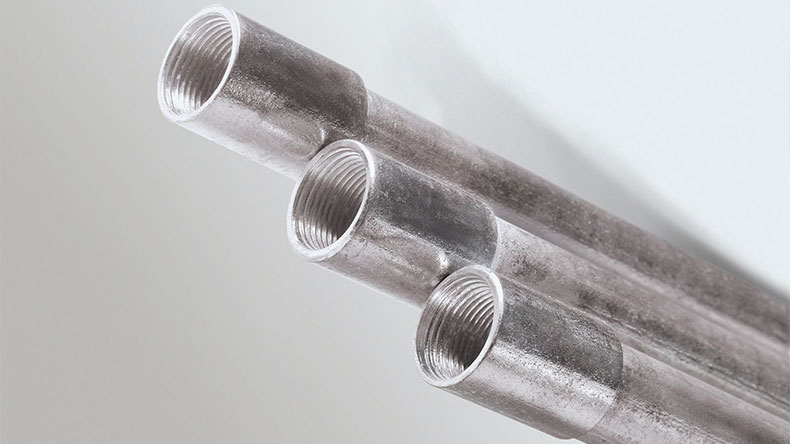
Hot-dip galvanized steel conduit is a type of steel conduit produced through a galvanizing process with a hot zinc coating to increase resistance to corrosion and rust. Due to its special characteristics, this type of conduit is used in various applications:
Water supply systems: Hot-dip galvanized steel conduits are widely used in water supply and water distribution systems. Their galvanized coating prevents rust and corrosion in contact with water and provides a longer service life.
Construction: In construction projects, these conduits are used to build frameworks, towers, and support systems. The high strength of the steel and its resistance to weather conditions make them a suitable choice for exterior structures.
Oil and gas industries: Hot-dip galvanized steel conduit is used in oil and gas piping systems because it can withstand high pressures and harsh environmental conditions. These conduits are typically used in the transmission of liquids and gases from sources to facilities.
Industrial infrastructures: These conduits are used in various industries for constructing ventilation, sewer, and other liquid and gas transmission systems. The galvanized coating allows them to work in humid and corrosive conditions.
Electricity transmission: Galvanized steel conduits are also used as electrical channels, where there is a need to protect cables against physical and environmental damage.
In general, hot-dip galvanized steel conduit is considered a suitable choice for many industries and applications due to its durability, corrosion resistance, and flexibility.
The strengthening of steel conduits is carried out by immersion in a bath of molten zinc. In other words, a large volume of molten zinc solution is prepared at high temperature, and the conduits are submerged in this solution. The purity level of this molten material is approximately 98%, indicating its high quality. The zinc solution has a very high spread rate, meaning it can coat the finest open pores present on the internal or external part of the conduit.
However, these pores may not be visible to the naked eye. We also note that before being coated with zinc material, the hot-dip galvanized conduit is first degreased and cleaned in a separate process using a series of mild acidic solutions so that it has the necessary conditions to accept the zinc layer.
To produce hot-dip galvanized steel conduit, it is first necessary for these conduits to be completely made of steel metal and used in dimensions and sizes suitable for producing galvanized conduit. The stages of producing hot-dip galvanized conduit are as follows:
In the first step for producing hot-dip galvanized conduit, the conduits must be prepared. To do this, the surface of the conduit must be completely degreased so that any foreign material is cleaned from the conduit. Then, by immersing the conduit in hydrochloric acid, rust, paint, and welding residue can be removed from the conduit. After doing this, the conduit can be rinsed. For rinsing the de-rusted conduits, a 30% ammonium chloride solution needs to be used.
After preparing the steel conduits, it is time to galvanize them. To do this, the metal conduits must be galvanized using molten zinc. For this purpose, the cleaned conduits are immersed in molten zinc at a temperature of 460 degrees Celsius so that a molten zinc coating is placed on these conduits. The thickness of the zinc layer placed on these conduits can vary from 35 micrometers to 650 micrometers based on need. After the conduits cool down, their surface will become bright and shiny, and a silver-colored surface will be created on the hot-dip galvanized conduits.
The final stage for producing hot-dip galvanized conduit is the final inspection. After the completion of the initial stages, the thickness and appearance of the zinc coating on the galvanized conduits must definitely be examined. To do this, the galvanized conduits are sent to metal factories so that their characteristics can be examined and tested.
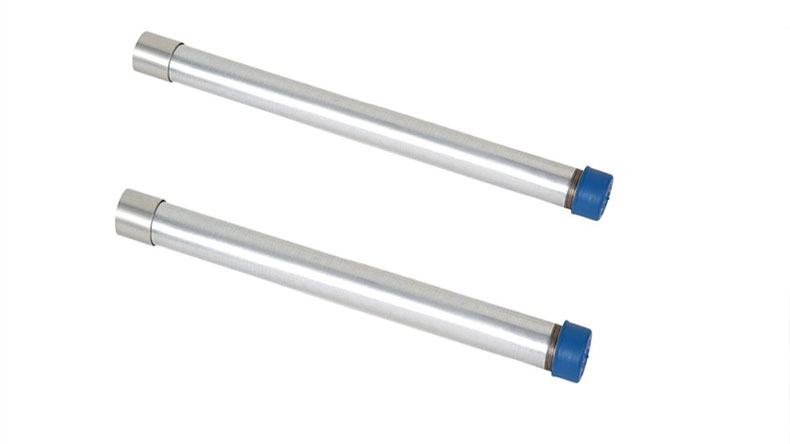
If you are looking to set up an extensive conduit installation project in an industrial complex, you should not worry about the size of the hot-dip galvanized conduit, because, based on defined standards, various sizes of this product have been designed and manufactured. Types of hot-dip galvanized conduit manufactured to support electrical cables vary from models PG11 to PG48.
The smallest size of these conduits has an outer diameter of 18.6 millimeters, and the largest has a diameter of 59.3 millimeters. Furthermore, many manufacturing companies, while observing engineering and structural standards, try to offer sizes beyond these mentioned types, which are classified in the customization field.
In an electrical cabling project, you may need to use several size types of hot-dip galvanized conduit to be able to carry out the process of supporting electrical cables properly.
You can connect hot-dip galvanized conduit to the ceiling using a series of structural fittings. In such conditions, less space will be occupied, and the electrical cables will be routed to the relevant location in the fastest time. Given that the conduits are suspended, we must definitely use a set of strong connectors to hold the conduits so that their safety and stability are also maintained.
Another application of hot-dip galvanized conduit is wall connection. By routing electrical cables along the wall area, a high level of order can be created in industrial environments. Furthermore, if the volume of cables is high, wall paths can prevent cable clutter and scattering.
If, for any reason, exposed paths on the structure are not feasible for installing conduits, these conduits have the ability to be placed embedded within the structure or buried under materials. For example, many high-voltage cables drawn from electrical transformers are routed into the structure through buried steel conduits. However, this type of installation has limitations for black steel conduit.
Dear customers can purchase various types of hot-dip galvanized steel conduit as well as cold galvanized conduit in different sizings from Rafi Industrial Group. We, as a manufacturing company, provide you with the highest quality parts at the most reasonable price so that you can have a safe and highly stable electrical conduit installation project.
To receive free consultation, please fill out the form below. Rafi Industrial Group consultants will contact you as soon as possible.
To receive free consultation, please fill out the form below. Rafi Industrial Group consultants will contact you as soon as possible.