Rafi Industrial Group | Manufacturer and supplier of power cable support equipment


For a cable tray to be implemented at the highest level of safety in a structure, it requires two general types of fittings. One type is related to external or structural fittings, meaning these parts connect the cable trays directly to the structure. The other type of these parts are internal or inter-tray fittings, which extend the path and create multiple direction changes along the cabling route.
We will discuss exactly what these parts are called and what features and structural specifications are attributed to them in the continuation of the article. Given the precise details we provide about these parts, reading this article can certainly be a comprehensive and useful guide for obtaining cable tray fittings.
The body material of various types of cable trays and their fittings is usually metal so that they are capable of bearing diverse thick and heavy cables. Nevertheless, one of the disadvantages of metal is insufficient strength against moisture. For this reason, a coating called galvanized must be applied to the iron and steel body of the cable trays to multiply their resistance. The necessity of galvanizing cable tray fittings is as important as that of the cable tray itself and must be carefully considered. For the following reasons, you must definitely carry out the galvanizing plating process on the fittings in addition to the cable tray.
Increasing mechanical resistance: A galvanized coating can be used to increase the mechanical resistance of cable tray fittings. This coating increases the load-bearing capacity of the tray fittings, increases tolerance to pressure, impact, and abrasion, and prevents mechanical stresses.
Increasing resistance to temperature changes: Galvanizing the fittings minimizes their sensitivity to temperature changes, so that if they are exposed to heat and cold, they undergo less dimensional and size changes. This contributes to greater safety in using these fittings.
Increasing resistance to moisture: Since metal cable tray fittings have low resistance to moisture, they can be coated with a special coating to increase the resistance of these metals to moisture. With galvanization, the probability of rusting of these fittings is minimized, and increased resistance to decay and rust can also be observed.
Increasing chemical and corrosion resistance: In industries where the presence of chemical and corrosive substances is high, using ordinary cable tray fittings is not sufficient, and a corrosion-resistant coating must definitely be created. Galvanization increases the durability of the tray and its fittings against specific chemical conditions.
Uniformity of the tray and fittings: By galvanizing the fittings and the cable tray simultaneously, optimal use of both of these products is possible. Since galvanization can cause a change in the appearance of the fittings and trays, it is recommended to also obtain the fittings with a galvanized coating for visual uniformity.
The best type of galvanizing for cable tray fittings is hot-dip galvanizing. Hot-dip galvanizing involves a thick zinc coating and can create a resistant coating on these fittings. The hot-dip galvanization process is carried out through a simple process called immersing the fittings in a bath of molten zinc and can create a uniform and moisture-resistant coating. However, since this process usually involves a high cost, it is recommended to use fittings coated with cold galvanizing for environments where there is no high moisture sensitivity.
Cold galvanizing creates a thinner layer of zinc on the surface and has lower strength against moisture and corrosive factors. In any case, both the cold galvanization process and the hot-dip galvanization process can play a vital role in the durability of this equipment and create a completely uniform coating against impact, moisture, chemicals, and corrosive factors.
A cable tray is a rectangular, channel-shaped object that can be used on the ceiling, wall, and anywhere cable transmission is needed. Cables are not always meant to be drawn straight along the wall or ceiling; rather, sometimes a change in their angle will be needed, and this necessitates the use of various cable tray fittings to safely transmit the cables. These fittings, while connecting the cable trays to each other, can also give them an angle.
Various types of cable tray fittings, including elbows, galvanized rods, supports, etc., can play an effective role in improving the transmission of cables through the trays. Practically, without these fittings, it would not be possible to transmit cables, and this matter can help remove cabling limitations in various buildings and allow wires and cables to be transmitted with high flexibility in different areas of the building, especially areas that are exposed to greater damage.
One of the common questions from customers for purchasing cable tray fittings is the price. The price of cable tray fittings depends on various factors, including the material of these fittings, the type of coating on them, and their structure. Obviously, the more resistant the material of the cable tray fittings, the higher their price will be. The material of these fittings and the type of coating applied to them to increase resistance also affect the price.
It should be noted that because these fittings must be used over a long period, it is very important that they have high quality and are made of the best metals. Otherwise, they will be prone to corrosion and rust. Therefore, construction contractors must pay attention to ordering cable tray fittings with the best quality according to their needs.
Now that you are familiar with the various types of fittings for cable trays, you may be uncertain about choosing each of them. In general, to use the appropriate fittings for connecting cable trays, you must take into account the cabling and wiring plan. The length of the path, the curves, and also the angles of the cables during wiring are of great importance, and the tray along with its fittings must be installed in such a way that their performance in the buildings can be utilized.
Therefore, the appropriate fittings for cable trays must be selected based on the need and the prepared drawings. Also, if necessary, electrical cable ladder fittings can be used alongside these fittings so that the best electrical cables and wires can be used safely and organized in various buildings.
This type of fitting is not installed between two trays; rather, their application is external and structural. Ensuring the safety of the cabling project depends to a very large extent on the correct implementation of structural-type cable tray fittings, because if these parts are loose and their standard implementation is lacking, the probability of collapse increases in the long term. Therefore, it is necessary to use them at the correct structural points with precise knowledge of these parts.
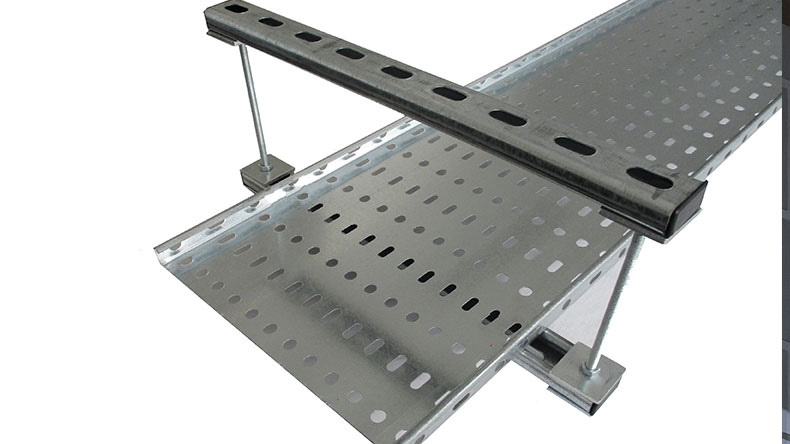
Galvanized supports are among the most essential parts that can bear the overall load of the trays and electrical cables. These parts are attachable to walls and ceilings, and by fully supporting the trays, they control their weight. In the ceiling-mounted state, they are placed under the trays by creating an L-shaped design and lead to the stabilization and stability of the cabling path.
Brackets are relatively smaller parts that usually act as a complementary component, meaning that suspended ceiling supports can create an L-shaped design using brackets. Of course, mounting these cable tray fittings onto the supports is feasible at any height from the ceiling.
C-channels are parts that have two types of applications in cable tray installation projects. Their first application is to be placed as a support piece under the cable trays, and their second application is to be directly attached to the ceiling. In such conditions, to support the trays, we need galvanized rods so that we can place a C-channel piece under the trays and then attach it to the ceiling.
These types of cable tray fittings are long steel pipes that are often designed in a fully threaded form. These parts are capable of accepting nuts on both sides and are abundantly used in the suspended installation of cable trays. Cutting is possible at any length, and you can use various lengths of them based on the measured criteria.

Internal-type cable tray fittings are parts that are usually installed between two trays. Given that cable trays are typically designed and manufactured in limited lengths of two meters and three meters, it is consequently necessary to use these internal fittings along a single tray installation path to provide the required conditions for continuing the path and also changing the direction of the trays.
These fittings, while simple in structure, are very practical. That is, if you fail to provide these important and vital parts, you naturally cannot complete a successful and ideal project. Given the wide range of cable tray connectors, some of the most important ones are as follows:
Cable tray elbows have a very high variety. Among the most widely used are internal vertical elbows or internal risers, external vertical elbows or external risers, adjustable internal and external vertical elbows, and horizontal elbows. Each of these cable tray fittings is used to create a 90-degree change of direction in the horizontal and vertical path.
Tees are connectors that include one inlet and two outlets, meaning that the cables are routed and guided in two paths: straight and 90 degrees. In fact, these parts both play the role of elbows and can also extend the cable path in the straight direction.
These connecting parts have the capability to guide electrical cables in four separate paths. Given the structure of cross fittings, they are usually not used alongside walls; therefore, their best performance is when you want to connect four cable trays to this part at the center of a structure.
Cable tray reducers also have a high variety, classified into types such as right reducer, left reducer, and center reducer. The structure of these cable tray fittings is such that they have two different cross-sections: smaller and larger. These parts are used when it is necessary to use two cable trays of different sizes.
Rafi Industrial Group is a manufacturer of a wide range of cable trays in various sizes, cable tray fittings, cable ladders, cable ladder fittings, galvanized trunking, various types of supports, and other power cable support and protection equipment.
These parts have high manufacturing quality and, due to their galvanized coating, will have high efficiency over a long period of time. Dear customers can contact the experts at Rafi Industrial Group to receive pricing information on the products as well as to become more familiar with their technical details.
To receive free consultation, please fill out the form below. Rafi Industrial Group consultants will contact you as soon as possible.
To receive free consultation, please fill out the form below. Rafi Industrial Group consultants will contact you as soon as possible.