Rafi Industrial Group | Manufacturer and supplier of power cable support equipment


The electrical junction box is an essential tool for any electrical project, specifically designed for managing electrical connections. With the ability to divide and route cables to various paths, these boxes enhance the safety and efficiency of electrical systems. Electrical junction boxes are available in various types, such as surface-mounted and flush-mounted, and can be made from various materials such as plastic, aluminum, or galvanized sheet. In addition to use in residential projects, electrical junction boxes are also used in commercial and industrial spaces and reduce potential risks arising from incorrect connections. With their resistant design and unique features, these boxes play an important role in maintaining the optimal performance of electrical systems. Choosing the right junction box can guarantee the correct and safe operation of the electrical network in any environment. 🔋
In the power distribution industries, there is always a significant challenge for connection and branching points. The electrical junction box is a small metal part, yet with a suitable application, playing a very important role in building and industrial electrical wiring. This part is used for managing, branching, and protecting wire and cable connections.
Electrical junction boxes are produced in plastic and metal types and in various dimensions to be used according to environmental conditions and the type of project. Using small and large junction boxes along the cabling path provides easy access to the connections and simplifies the work if repair or expansion of the electrical network is needed. For this reason, this product has wide application in residential, commercial buildings, factories, sheds, and industrial projects.
Choosing the right junction box increases the organization, safety, and durability of the electrical wiring system. Resistance to environmental factors, easy installation, and increased useful life of cables are among the most important advantages of using this small part, which itself has several types—small, large, and explosion-proof—to create an isolated space for housing electrical cables and wires.
| Feature | Description |
|---|---|
| Box type | Surface-mounted / Flush-mounted |
| Body material | Aluminum / Galvanized sheet / Plastic |
| Dimensions | 20x20x10 cm / 30x30x15 cm (Various sizes) |
| Number of terminals | 4 / 6 / 8 (According to need) |
| Cover | Metal / Plastic |
| Moisture resistance | IP54 / IP65 |
| Impact resistance | IK08 |
| Color | White / Black / Gray |
| Installation | Bolts and nuts / Compression fitting |
| Application | Residential, commercial, industrial |
| Operating temperature range | -20°C تا +70°C |
Junction boxes are divided into the following two general categories based on the
This type of box is installed directly onto the surface of the wall, ceiling, or electrical panel. Their installation is relatively simple and does not require creating a cavity in the wall. Surface-mounted junction boxes are usually used for visible wiring or when flush mounting is not possible (such as in old buildings or workshops).
The most important advantages of these junction boxes are quick and easy installation, easy and convenient access for repairs, and no need to break the wall for installation. However, these boxes do not have a very aesthetic appearance and may not match the interior decoration.
Flush-mounted junction boxes are installed inside a cavity created in the wall, ceiling, or floor. Only the front part of these boxes with the cover is visible. This type of installation method gives a clean and tidy appearance to the wiring system and coordinates well with the interior decoration.
The main advantage of the flush-mounted junction box is its very beautiful and integrated appearance with the environment, providing greater protection for the connections against impact and external factors. However, installing these boxes requires more time and is more complex. Moreover, there is more difficult access for repairing the internal wires and cables of this type of box.
Using industrial and domestic junction boxes brings many advantages to the electrical wiring system and multiplies safety and organization.
Increased safety: The most important advantage of using these boxes is protecting electrical connections against accidental contact, moisture, dust, and physical damage, which significantly reduces the risk of electric shock and fire.
Organization and order: Cast iron and plastic junction boxes help with branching and organized cable management and prevent wires from tangling.
Easy access for maintenance: By providing a central point for accessing connections, these junction boxes simplify the inspection, repair, and maintenance process of the electrical system.
Resistance to environmental conditions: The boxes can protect the connections against water and dust ingress, which is very vital in humid or industrial environments.
Creating standard branching points: With the presence of these boxes, it is possible to create safe and standard branches for distributing electricity to different parts of a building or facility.
Reducing stress on cables: By correctly guiding the cables into the box, improper stretching and pressure on the connection points are prevented.
Installing junction boxes in various projects also creates a series of limitations, the most important of which are mentioned below.
Limitation on the number of connections: Each junction box has a specific capacity for the number and type of connections. Exceeding this capacity can lead to excessive heating and increased risk.
Space limitation: In some junction boxes, especially flush-mounted types or small boxes, there is not enough space to make complex connections or use large terminals.
Heat dissipation: Electrical connections in the junction box generate some heat under heavy load. In poorly ventilated boxes or if a large number of connections are installed, this heat can accumulate and damage the cables or the box itself.
Additional cost: Installing a junction box adds material and labor costs compared to directly connecting the cables to the system.
Installation limitations in some environments: Surface-mounted boxes may not be aesthetically acceptable in residential or office environments.
Need for expertise: Although installing surface-mounted boxes is simpler, making the internal connections and ensuring their safety and standardization requires technical knowledge and adherence to electrical wiring principles, especially when installing boxes in a flush-mounted manner.
The history of electrical junction boxes is related to the history of the emergence and development of power distribution systems. Below is an overview of the history of electrical junction boxes:
In the early 19th century, with the development of power distribution networks in cities, the need for boxes to centrally divide and manage electricity was felt. These boxes were initially made of wood and metal.
In the following decades, with the advancement of technology and manufacturing materials, electrical junction boxes were improved in plastic, fiberglass, and metal forms. These materials were more diverse in terms of insulation and resistance to environmental conditions.
In the 20th century, with the increase in the widespread use of electricity and the growth of distribution networks, global standards for the manufacture and use of electrical junction boxes were established. These standards include items such as standard dimensions, manufacturing materials, mechanical and electrical performance, and safety.
In recent decades, with technological advancement, smarter electrical junction boxes equipped with more advanced control tools have been designed and manufactured. These boxes feature capabilities such as wireless communication networks, smart sensors, and remote programming.
In general, the history of electrical junction boxes is in step with the development and progress of the electrical industry and its technology, and over time, these boxes have experienced various improvements.
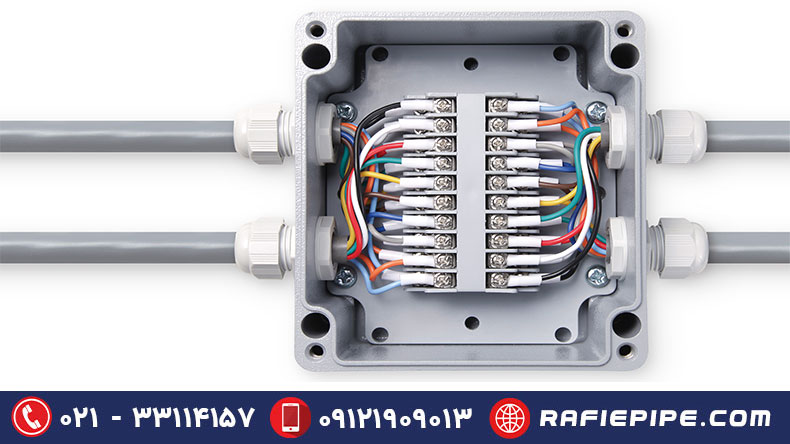
One of the important points considered in internal wiring and cabling processes is the ability to route cables according to established principles and rules with high safety along specified paths. Some negligence may occur regarding the selection of a standard junction box. For this reason, before the high-risk consequences emerge, it is necessary to know about their necessity.
When the polymer sheath of electrical wires is stripped to create various connections, there is a risk of electric shock under any circumstances. Therefore, a junction box, by creating an isolated and enclosed space, will be a safe place for connections. Another consequence of using a junction box is that the organization of connections at the correct point increases. Any disorder created in a wiring and cabling path will make its management difficult, burdensome, and costly in later stages.
Junction boxes are used to maintain the integrity, order, and cohesion of the network. So a junction box can prevent the scattering of connections and house all connections in an enclosed chamber. Alongside this, the ability to connect electrical conduits is also easily achievable. These conduits can be in steel conduit, plastic conduit, and even flexible conduit models, all of which are directly routed into the junction boxes.
Furthermore, aluminum junction box types, galvanized sheet boxes, plastic types, and even models with glass and transparent covers have been manufactured to be used in various situations and conditions. If you do not use a standard junction box with a high-quality and resistant structure, there is a possibility of network disconnection at any moment. Due to the many stresses present in various work environments, any type of connection without a junction box and internal terminals easily provides the necessary conditions for failure and power loss. Therefore, never connect terminals without a metal box outside of it to the wall, ceiling, and other places.

When you purchase an electrical junction box, the most important stage, which is installation and connection within the structure, begins. Right at the outset, we must say that you do not have a very simple process ahead, because any incorrect connection and error in the network not only trips the circuit but can also cause other risks such as fire, severe short circuits, damage to equipment and devices, and other incidents. We must definitely select these metal boxes based on the engagement elements present in the environment. Whether you need galvanized, aluminum, or plastic models is important, and you must examine the features of each and see whether they are suitable for your project or not.
The number of branches present along a path, the type of conduits that are to be connected to these boxes, the number of internal terminals, the dimensions and standard size of these metal boxes must all be correctly selected. This matter becomes important when the scope of the project increases and you must complete a complex wiring installation.
It is usually necessary to use several junction boxes in each structure, both in its interior and exterior sections. In that case, the paths leading to each must be correctly chosen. Paying attention to the different directions and paths of the wiring and installing these boxes at various points of the structure may be somewhat time-consuming in completing the project, but you must definitely use professional installation and connection teams so that no technical defects or faults arise.
One of the important features that can be mentioned for junction boxes in various types, such as plastic types and even metal models like galvanized and aluminum, is the electrical insulation of the body of these boxes. Of course, plastic materials generally have this feature. However, for metal types, it is necessary to prevent the transmission of electrical current to the body of the metal sections through a series of techniques and fundamental measures. We are all familiar with terminals and know that they are sockets placed as bases inside the box and are responsible for the connection.
Usually, these sockets or terminals have two metal pieces in their inner section, but their surroundings are completely made of polymer or plastic. Some of them are also designed in a ceramic form. Generally, plastics and non-metal boxes do not conduct electrical current through themselves.
For this reason, when terminals of such material are placed inside the box, they do not cause electricity to be transmitted to the body.
If your box or junction box has terminals, it is definitely necessary to place these practical sockets inside the junction boxes so that through this, you can have a strong, safe connection with high security. Therefore, never try to connect electrical wires and cables to each other without terminals, because in that case, the connections are free and can come into contact with the body of the metal boxes at any time. Many manufacturing companies also try to supply these metal boxes with their accessories to customers so that you can have a successful installation and implementation.

The domestic electrical junction box is one of the very widely used products mostly employed for residential building projects. A wide range of these boxes is available for creating electrical wiring networks in apartments and commercial structures. Given that residential buildings are not as high-stress as industrial spaces, specific models of these boxes are used.
In terms of application type and structure, all junction boxes provide the same services, except for explosion-proof models, which have a completely different application. In all of these, there are electrical terminals, and the connection point of the electrical cables for branching is located in these terminals. Domestic terminal-equipped junction boxes are employed before the architecture of the structure is completed. They can even be used in a surface-mounted manner after the project is finished.
The junction boxes used today in industrial spaces and commercial and residential structures are only one of the applications of these products. Another example of the use of these boxes is in the process of manufacturing and producing electrical equipment. If you pay attention to the internal compartment of evaporative coolers, you can see a small polymer box located in the upper corner of the cooler. In this plastic box, there are a number of terminals, which are the connection point for the electrical wires.
The electrical junction box inside the evaporative cooler not only protects the connection points but also facilitates and simplifies the management of the internal wiring of this electrical appliance. With these small boxes, the safety of the power distribution network for this appliance will be provided, and you can use this appliance without electrical problems. Of course, this was one type of use of distribution boxes for manufacturing electrical equipment, as there is a wide range of appliances whose electrical systems are completed with exactly these boxes.

According to standard definitions, junction boxes are used in two different environments: environments with moderate or lower stress intensity, and spaces with a very high working risk level. In both of these, different approaches are followed for the cabling processes. For example, if a work environment deals with various explosive or flammable materials, we cannot use ordinary junction boxes.
Because in that case, it will create significant risks. Due to conducting electrical current, electrical connections may, for various reasons, undergo a sudden electrical discharge in the form of a short spark at the connection points. This matter is completely natural because the smallest environmental elements affect the electrical connection points. Even the atmosphere and humidity present in the air, if they increase beyond a certain limit, will also affect the cabling network.
Imagine the surrounding space is full of flammable materials; consequently, any short circuit can cause massive explosions and fires. For this reason, engineers have designed and manufactured the explosion-proof metal junction box, which protects the electrical connection points, and the occurrence of any internal spark will have no effect on the environment.
Therefore, if you think your industrial workshop has high dangers and risks, definitely use the explosion-proof junction box. These boxes differ from ordinary models in every respect. The structural material, design type, geometric shape of the cover, and the overall form of these metal boxes are completely engineered and intelligently constructed.
Managing the cabling network after the installation and connection of the junction boxes in the structure is extremely important. An important matter we must consider is that in the long term, it may be necessary to make a series of changes in the cabling network, the cable path, and also the connections. When the junction box is present in the network, these operations are easily feasible.
Due to the numerous branches these boxes have, change, replacement, and the creation of new branches will be feasible in the shortest time. For installing an industrial junction box in a structure, a standard height is usually chosen so that environmental factors cannot unconsciously access the connection points. This very factor will ensure these boxes are at the highest level of safety.
Some of these models, such as the plastic surface-mounted junction box, are installed on the surface of the structure. However, others are flush-mounted, meaning a separate enclosure is created inside the structure so that the boxes can be used in a flush-mounted manner. Therefore, greater protection will be created for both the box and the connections. In general, we must focus our priority on creating safety in the cabling systems, so that in addition to suitable paths for connecting the cables, we also place the junction box in the correct position. Of course, in the execution process, it is better for experienced executive technicians to be in charge of the operation.

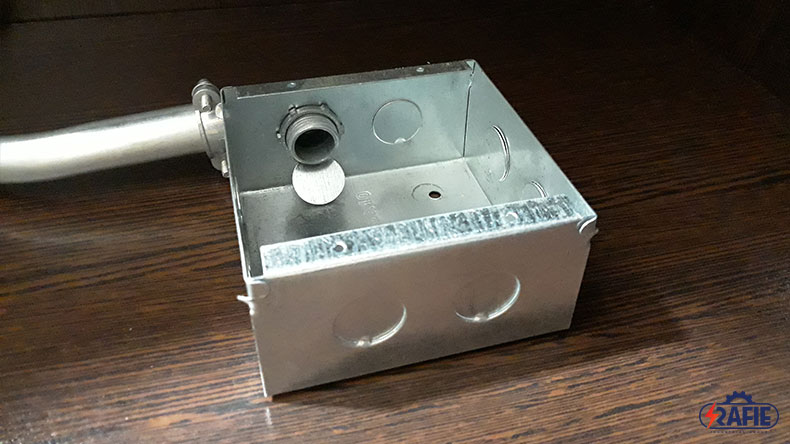
If you look around various types of junction boxes, whether galvanized, aluminum, or plastic, you will see holes that exist around the junction boxes. These holes or punches are designed so that you can place the electrical conduits inside them. This intelligent measure and ideal design increases the safety of electrical wiring and cabling. Usually, cables cannot be routed from the external part of the boxes into them; consequently, designers create a number of holes in the junction box so that the conduits enter the box, and through this, the cable connection process is completed.
For each junction box, the number of holes will vary based on its size. In fact, the objective pursued for using the electrical junction box is to have one input from the power source and to be able to create several branches in the form of outputs to various points and different directions. One of the fundamental questions always raised about these boxes is: what exactly is the size of these holes, and what type of conduits can be used with them?
To answer this question, we must say that there are currently 3 main sizes of conduits that are abundantly used with these boxes. These conduit sizes are PG13.5, PG16, and PG21. To connect the electrical conduits to the junction boxes, we need another accessory part so that the conduits are completely stably and firmly connected to the boxes.
These connecting parts are the same metal glands that are placed at the end of the conduits and through this are connected with high safety through the holes present in the box body. Of course, at the time of purchasing a custom electrical junction box, you can change the size of the box holes.
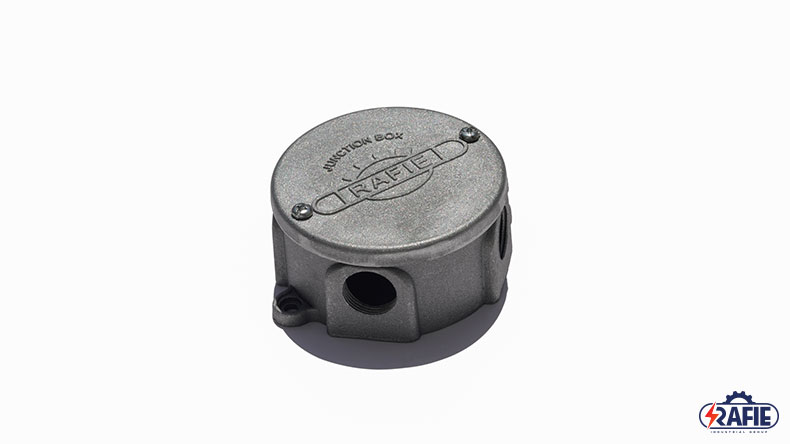
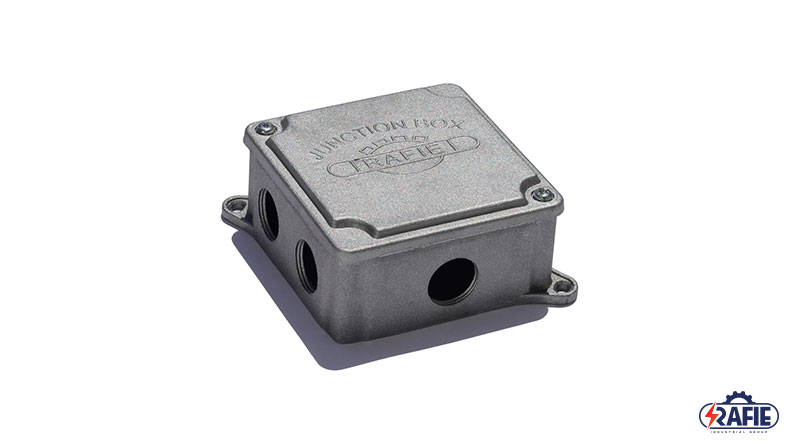
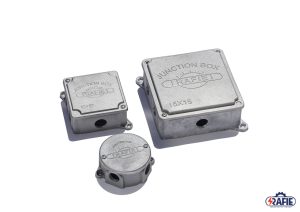
The aluminum junction box, as its name suggests, is made of high-density aluminum material. They have very high body resistance and strength and can protect the connections inside the box against environmental stresses such as impact. Given the type of metal used in the manufacture of these boxes, there is usually a possibility of their corrosion in humid environments. For this reason, various types of powder paint are used on the body of this electrical junction box, which can provide ideal chemical protection for these junction boxes.
Due to having a resistant cover, no type of dust can penetrate the location of the cable connection terminals. In addition to fine particles, water fluids are also unable to penetrate inside the box. Once the cover of the electrical junction box is completely closed, it creates an all-around seal that causes the internal terminals of the box to be completely separated from the outside environment. Due to their very beautiful appearance, aluminum junction boxes are usually used in a surface-mounted manner in various environments. If for any reason they need to be exposed to environmental weather or direct sunlight, there is no cause for concern, as these boxes maintain their structure without damage even under such conditions.
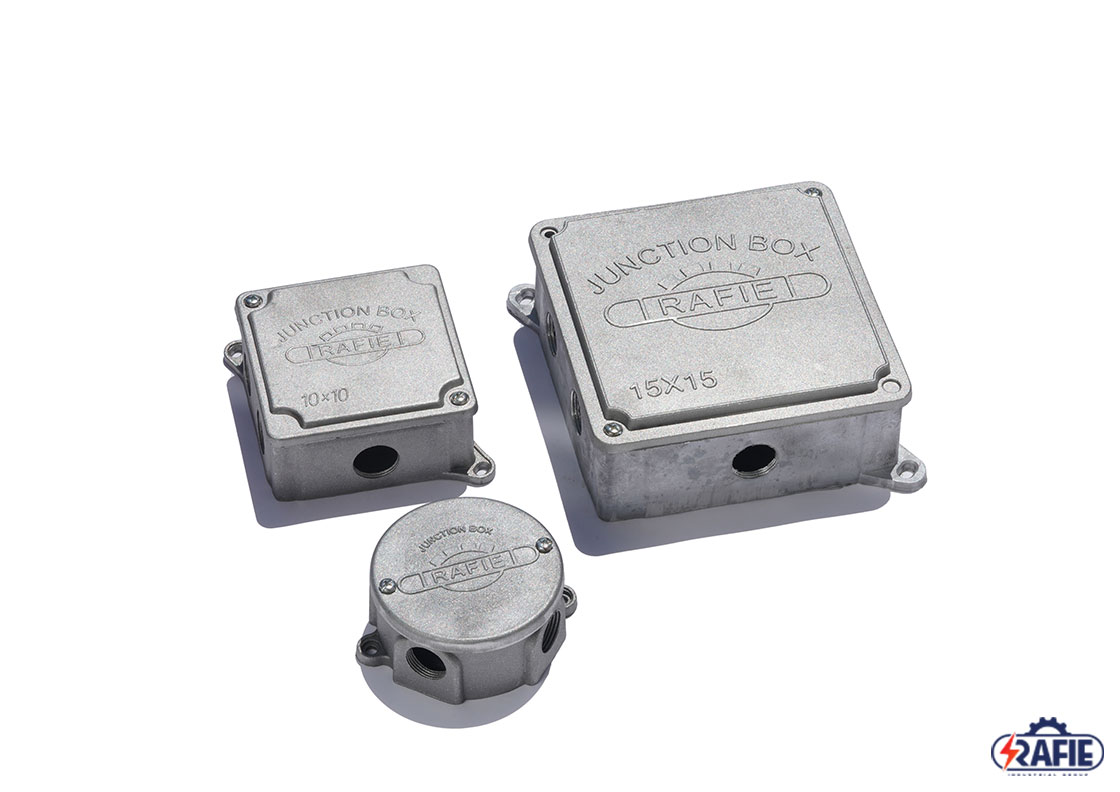
In terms of structural dimensions, they have three dimensions: length, width, and depth or height of the box. The most common dimensions considered for these junction boxes include length and width of 8×8, 10×10, 10×15, 13×13, 16×16, 17×19, and 19×25. In terms of depth dimensions, they have dimensions of 6, 7, and 9. All these mentioned dimensions are in centimeters.
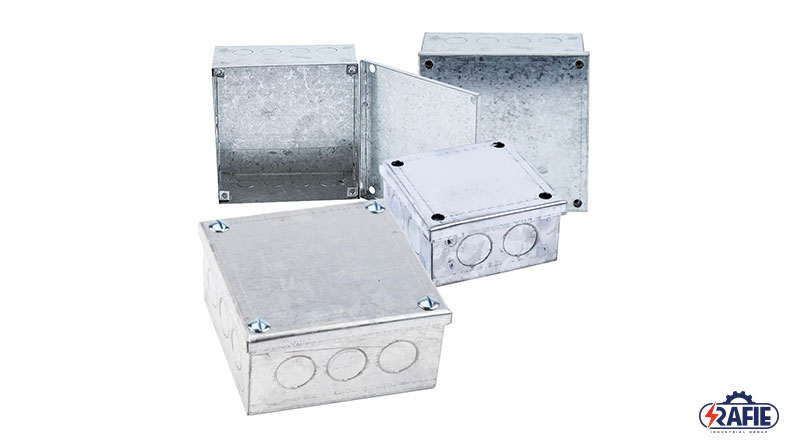
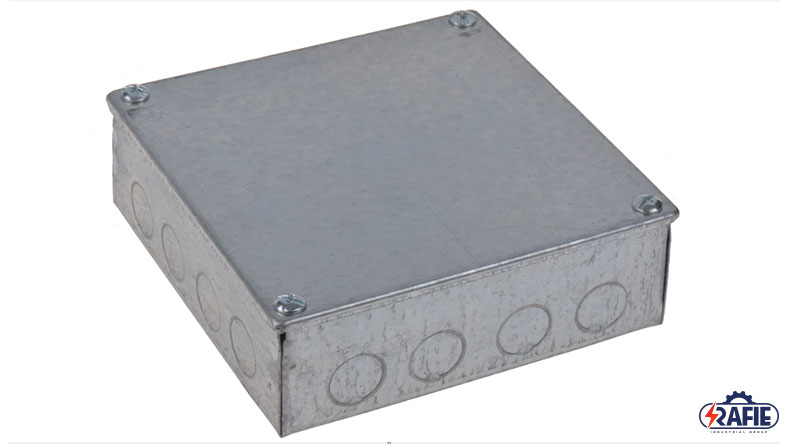
The galvanized junction box is made of resistant stainless steel or steel sheets. To prevent rust and corrosion of the steel sheets, two methods—hot-dip galvanizing and cold galvanizing—are usually used to coat these boxes. Hot-dip galvanized types, due to the use of molten zinc compounds at high temperatures, practically have a higher resistance intensity compared to types with cold galvanized coatings.
The geometric shapes of this type of electrical junction box can be square or circular. In terms of external appearance, compared to aluminum electrical junction boxes, they are less aesthetic. Therefore, it is preferred that they be used in industrial environments such as workshops and also sheds that have various technical devices and equipment.
To carry out branching with this electrical junction box, conduit networks with various types of steel conduits as well as flexible conduits can be used. These boxes also have a sheet cover to protect the internal connections. Punched holes are provided in the body of the galvanized junction box.
The dimensions of the galvanized electrical junction box are in sizes of 7×7 cm, 8×8, 10×10, 15×15, and 20×20 cm. Boxes with larger dimensions will naturally support a greater volume of cable connections and can also have more extensive branches.
Since the galvanized junction box is among the most widely used metal boxes in various structures, it is necessary for individuals to have complete information in the area of technical specifications of the product at the time of purchase. In addition to being made of steel sheets with a galvanized coating, these boxes also possess a specific thickness.
Currently, you can purchase these boxes with sheet thicknesses of 0.7 and 0.9 millimeters. Of course, some manufacturing companies may use different thicknesses on a custom basis, but the mentioned types are among the defined standards. At this thickness, the weight of the box will always be kept at its lowest level. Moreover, due to the high density of the steel sheets, they will be completely resistant to environmental stresses such as impact.
Since these boxes are installed in a safe space, there is no need to use very high-thickness steel sheets. For the design and manufacture of other models of this product, such as the explosion-proof surface-mounted junction box, the production approach is completely different, and these boxes are usually in relatively greater thicknesses and with an extraordinarily stronger body.

On all types of flush-mounted and surface-mounted junction boxes, there is a resistant cover. Their connection type is also mostly in a screwed form, meaning the covers are placed on the box and attached to the main body through screws. Building electrical junction boxes and also galvanized types are no exception to this rule and have covers of the same material, meaning they are made of exactly the same galvanized steel sheets. The main objective of using these boxes is to prevent environmental elements such as various animals from affecting the connections. Of course, human factors may also accidentally affect the connections. Therefore, it is better to create a closed and safe space for the internal compartment with a fully screwed and firm cover.
Generally, a junction box cannot be used without its covers, because the safety of the cabling network is lost. Of course, due to their easy opening and closing, whenever you are looking for a change in the connections, you can open the covers, apply the changes, and screw them back onto the box. For some plastic models, transparent covers may also be used, meaning you can see inside the box from the outside. In many monitoring systems and CCTV camera installations, these electrical boxes are abundantly used.
Every type of junction box in different models, such as galvanized, plastic, and even aluminum junction boxes, has cavities and holes around it for the entry of conduits. Conduits cannot be placed freely and without any connecting part on the junction box. Therefore, we must use a secondary connecting part to be able to secure these conduits in a completely stable manner within the box body. Metal glands are among the parts abundantly used with junction boxes. We must definitely connect the electrical conduits to the boxes with these glands. Of course, in some cases, cables without conduits may be connected to the boxes and various types of panels. In this case as well, we must use various types of armored and unarmored cable glands.
There are various models of this product, each usable based on your project type. Single-screw and double-screw glands are extremely practical for connecting electrical conduits. The reason for their use is that if a tensile force is applied to various types of conduits, such as flexible conduits, steel conduits, etc., the connection point of the cables and conduits will not detach from inside the box.
When one or several of the junction box holes are not being used, you must completely block them. In such conditions, a series of covers have been designed and manufactured, which are generally known as plastic junction box covers.
By installing them, the hole openings are completely closed, and you no longer need to worry about the entry of various insects and creatures into the box. Their design type is such that they easily fit into the hole opening and are secured. At the time of purchasing the covers, you must also pay attention to their size, as various sizings have been designed for them. The structural material of the covers is mostly plastic or polymer. Furthermore, they are threaded and are easily screwed into the box body.
The plastic junction box is another widely used type that has a very beautiful structure, and their application is more in commercial, office, and also residential units. These electrical junction boxes can be installed at various points on the wall, and you can have several cabling paths in the building with various types of flexible conduits. Like the other mentioned types, they have a separate cover to provide all-around protection and can provide acceptable physical protection for the internal connections of the box.
The sizings of plastic electrical junction boxes include 11×11, 11×15, 11×21, 16×16, and 21×29 centimeters. As you can see, there are punches on the body of this junction box for the entry of electrical conduits.
An important point that exists and is a question for many buyers is: what type of junction box should we use in our structure? As mentioned, industrial and commercial buildings and structures are generally classified based on the intensity of stresses present around them. For this reason, most building electrical wiring engineers suggest that metal types must definitely be used for cabling in industrial buildings. In contrast, in structures with a low risk factor, you can choose plastic types. With this precise selection, you can definitely have fundamental budget management in purchasing various types of electrical junction boxes.
Dear customers can purchase various types of electrical junction boxes with aluminum, galvanized, and plastic materials of the highest manufacturing quality from Rafi Industrial Group. The price of these products is very affordable compared to market conditions. You can contact our experts to receive pricing information as well as obtain specialized consultation in the area of purchasing.
To receive free consultation, please fill out the form below. Rafi Industrial Group consultants will contact you as soon as possible.
To receive free consultation, please fill out the form below. Rafi Industrial Group consultants will contact you as soon as possible.
![Types of galvanized junction boxes, direct sale [Consultation + Price list]](https://rafiepipe.com/wp-content/uploads/2022/10/جعبه-تقسیم-گالوانیزه-02.jpg "Types of galvanized junction boxes, direct sale [Consultation + Price list]")