Rafi Industrial Group | Manufacturer and supplier of power cable support equipment


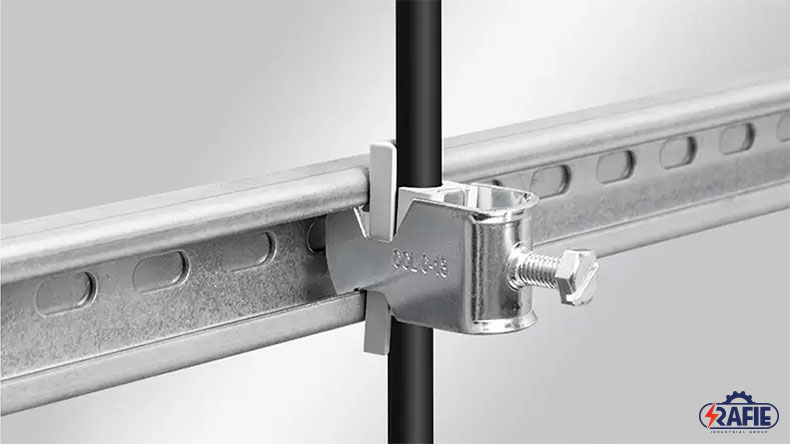
Unlike Spit clamps, clevis hangers cannot be used without a rail and must definitely be installed on a rail. The clevis rail is a metal product made of galvanized material with a specific width, allowing clevis hangers to be placed inside it for better stabilization. These rails provide excellent support for clevis hangers, and with their presence, electrical conduits can be used parallel to each other. Before purchasing clevis rails, you can stay with us in the following for details, technical specifications, and features.
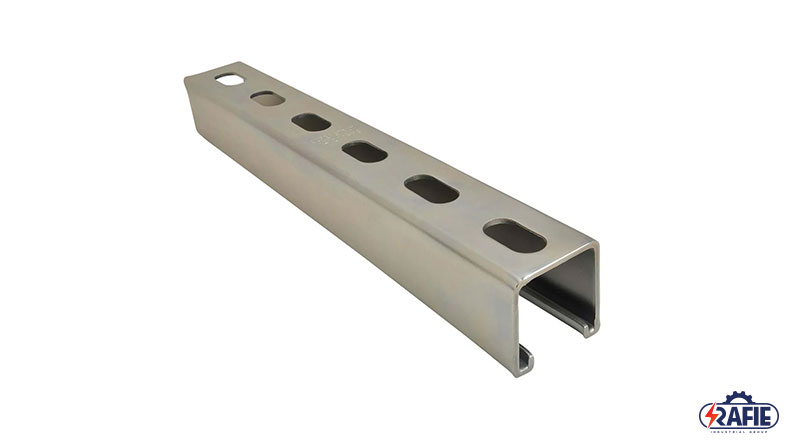
The clevis hanger rail, which is known in industrial electrical projects as C-Channel or Unichannel, is a steel profile with a C-shaped cross-section that acts as a foundational chassis for managing and stabilizing conduit pipes and electrical cables. This rail is produced as a type of building services support using galvanized sheets and has curved inner edges specifically designed to engage with the hooks of clevis hangers.
The structure of the clevis hanger rail allows for the placement of electrical steel conduits without the need for welding or separate drilling. Overall, the edges of the rail, by creating a rigid mechanical connection, provide high resistance to vibrations caused by current flow and the heavy weight of cables, and by providing the capability for horizontal installation, it significantly increases the speed of implementing electrical infrastructures in shed ceilings, risers, and electrical rooms.
The clevis rail, as one of the main components of a support system, along with equipment such as cable tray brackets, plays an important role in holding and stabilizing cable trays in horizontal and vertical routes. These products can be ordered in two types: plain and punched, each offering positive features depending on project needs and weather conditions.
Plain clevis rail: This type of rail has a completely plain sheet with no punches or holes on it. Therefore, the possibility of rainwater and moisture penetration into the rail is minimized, and there is no entry path for dust. However, the closed nature of this rail and the inability of airflow to pass through causes the temperature of the cables and wires used inside to rise.
Punched clevis rail: Among other types of clevis hanger rails available in the market are punched rails. These rails have small holes on their surface that help with air entry and keep the wires and cables cool. Typically, the holes on this type of rail are spaced 1 centimeter apart. The presence of these holes helps with better cooling and also allows dust to be discharged. In conditions where a high number of cables need to be moved with a risk of temperature increase, this type of rail can be used.
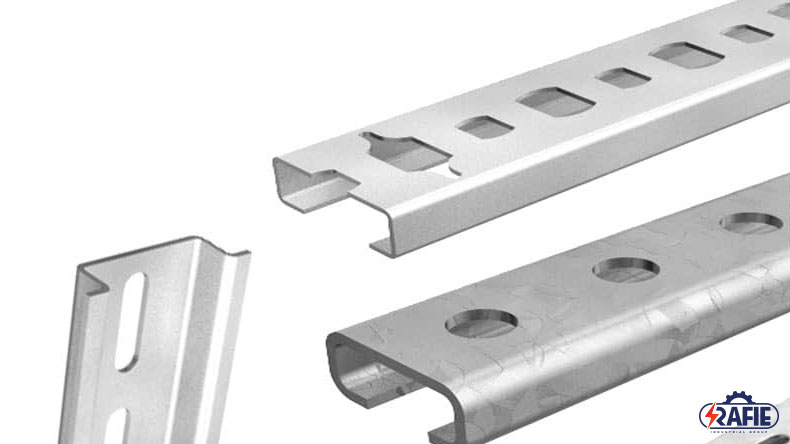
The material of products used for conveying wires and cables plays a very important role in their durability. Therefore, it is naturally necessary to pay special attention to the quality and material when selecting clevis hanger rails. These products can be used with factory-galvanized material or plated iron. In the factory model, galvanized sheets are used from the very beginning so that the rails are insulated from all sides, including the interior, exterior, and walls, and have very high resistance. In the plated model, the intended product is initially made from ordinary iron sheets, and afterward, the plating or galvanization process is carried out on these products. In this case, the rail is made from black iron sheet produced through the galvanizing process and also has acceptable resistance.
The price of clevis rails is one of the most important criteria for buyers when choosing this product. These rails have different price ranges depending on the type, material, and level of resistance; however, overall, they can be obtained at a reasonable rate and in various lengths. Each length and each model has a specific application, and this very factor leads to price variety. The most important factors affecting the price of clevis rails are as follows:
Rail material:
Clevis rails are usually produced from steel, iron, or aluminum. Although the most common models are made of steel, similar to electrical steel conduits, aluminum rails have a lower price than iron and steel types due to their lighter weight and simpler production process.
Type of galvanization:
The main factor determining the price is the type of galvanization. Clevis rails are supplied in two models: hot-dip galvanized and cold galvanized. Hot-dip galvanized has a higher price than the cold type due to the greater thickness of the zinc layer and higher corrosion resistance.
Rail sheet thickness:
The thickness of the sheet used in manufacturing the rails varies, and this factor has a direct impact on the final price. For projects where the rail is exposed to pressure, weight, or damaging factors, using a rail with high thickness is recommended. The higher durability and longer service life of these models make their higher cost completely logical.
Intermediary costs:
The presence of various intermediaries in the sales process increases the price of clevis rails. Direct purchase from Rafi Industrial Group eliminates these additional costs and makes it possible to obtain the product at the lowest possible price.

In order for the clevis rail to accommodate several clamps inside it, it must be bent by industrial machinery and equipment. For example, when clevis hangers are prepared for installation inside the rail, they can only be fully locked in place when the grooves and edges of the rail sit completely on the bases of the clamps. This important feature will be achieved when the C-channel rail has been precisely bent. According to defined standards, six bends are considered for each C-channel rail. By carrying out standard bending, the design and manufacture of the part is practically completed and it can be used within the electrical conduit network.
Due to the very high-quality and high-density steel alloy used to manufacture the clevis hanger rail, no damage such as fractures or cracks in the metal body will occur during the bending stages. Furthermore, hydraulic machinery and tools carry out the bending stages of the galvanized sheet. Therefore, both in terms of precision and fineness of the bend, they are at the highest level, and the final product, the clevis rail, will be prepared without the smallest structural defect.
The adequate resistance of clevis rails to moisture is an important factor in their performance and efficiency. In this regard, galvanized steel sheets are used to manufacture these rails. Galvanization creates a uniform coating of appropriate thickness to prevent metal deterioration under specific conditions. Galvanization of steel sheets is possible through two methods: hot-dip and cold. However, since the immersion method (hot-dip galvanization) deposits a greater thickness of zinc onto the sheet, it is the preferred method. Below, we examine how steel sheets are galvanized for clevis rails:
First, the steel sheets required for manufacturing the clevis rail are cut and prepared.
In a special tank, molten zinc solution is poured and prepared at a very high temperature of about 600 degrees Celsius.
The cut steel sheets are immersed in the molten zinc, in such a way that they are completely submerged and the entire surface of these sheets is coated.
The sheets are then removed from the molten zinc using suitable tools, and a layer of zinc with a thickness of about 10 microns forms on them.
To dry the molten zinc, the metal parts are placed in open air so that their temperature gradually decreases and dries.
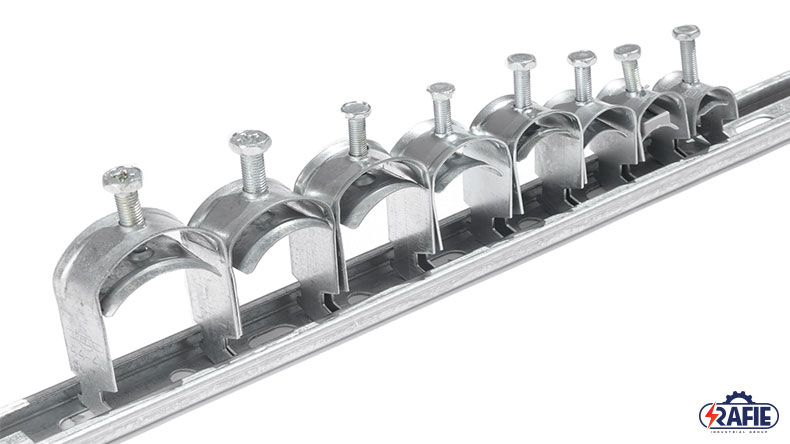
As mentioned at the beginning of the article, to create a strong support network, the clevis hanger rail requires a set of complementary parts. The most important of these parts is the clevis hanger. These clamps are designed in such a way that they practically connect the cables and electrical conduits to the C-channel rail. Due to the design and shape of these clamps, they easily fit inside the C-channel rail and, thanks to the specific curve at the base of the clamp, they lock completely onto the rail.
The C-channel rail also has a C-shaped cross-section. The curve present at the edge of these rails provides the conditions for the clevis hanger to be mounted onto these parts with the highest level of stability and safety. An important point about the clevis hanger rail is that, due to their long branch length, you can place several clevis hangers along the axis of the rails. Naturally, by increasing the rail length, it is possible to support several conduits and cables in a single path line.
Of course, to support various electrical conduits, the C-channels must definitely have a strong connection to the ceiling and wall surfaces, because although the weight of the electrical conduits is small, increasing their number can exert a considerable force at the C-channel connection point. Therefore, the main priority is the firm installation and connection of the C-channel to the structure.

Choosing the best material for manufacturing clevis rails has a very significant impact on durability, resistance to corrosion, and acidic and chemical conditions. In addition, the thickness of the sheet and the type of galvanization applied to the sheets of these rails can also improve their final performance. Below, we examine the technical specifications of these products in more detail.
Material: The best material for manufacturing clevis rails is steel or stainless steel. Other materials such as aluminum and brass can also be used to make these rails; however, since these alloys are considerably softer than steel, it is better not to use them.
Type of galvanization: To create a moisture-resistant coating for clevis rails, the hot-dip galvanization method is usually used. In this method, an adequate thickness of zinc is deposited on the rail surface and prevents the steel from rusting.
Sheet thickness: The thickness of sheets used for manufacturing clevis rails includes 1, 1.25, and 1.5 millimeters. The higher the sheet thickness, the greater the rail’s resistance; however, under standard conditions, it is better not to use sheets thicker than this range.
Punching: The cross-sectional surface of the clevis hanger rail has numerous punches and holes to allow the rail to be installed on wall and ceiling surfaces. The punches are usually fixed in place with hex bolts.
Standard dimensions: The standard height and width of clevis rails is usually 41 by 41 millimeters; however, the length of the rail branch can be considered from one meter to three meters depending on the needs of each project, and the customer can choose each according to their needs and transportation conditions.
The Spit clamp is among the very widely used parts employed at the heights of a structure for holding electrical conduits. Due to their two-piece structure, these clamps sit well on the pipe and restrain the weight of the pipes along a specific path. To use a Spit clamp together with a C-channel rail, it is first necessary to attach the clevis hanger rail to the ceiling. Then, using galvanized threaded rods, the Spit clamps can be connected to the channels.
Clevis hanger rails, or C-channels, are also commonly used to create suspended support systems for cable trays. You can use these C-channels to support cable trays in tiers. The work process is such that first the C-channels are connected to galvanized rods. By creating a U-shaped structure with galvanized rods on both sides and the C-channel in the center, you can create a suspended support.
Of course, it is also possible to use several C-channels in tiers together with galvanized rods, in which case you have created a relatively complex support network. You can clearly see the practical use of C-channels in suspended supports in the second image of the cable tray fittings article.
At Rafi Industrial Group, various types of electrical conduit fittings and other cable support parts are offered to customers at the highest level of quality. The set prices are very affordable considering the competitive market atmosphere. You can contact our experts to inquire about the purchase price of all products introduced on the website as well as to receive specialized consultation. What matters to us is achieving your utmost satisfaction.
To receive free consultation, please fill out the form below. Rafi Industrial Group consultants will contact you as soon as possible.
To receive free consultation, please fill out the form below. Rafi Industrial Group consultants will contact you as soon as possible.