Rafi Industrial Group | Manufacturer and supplier of power cable support equipment


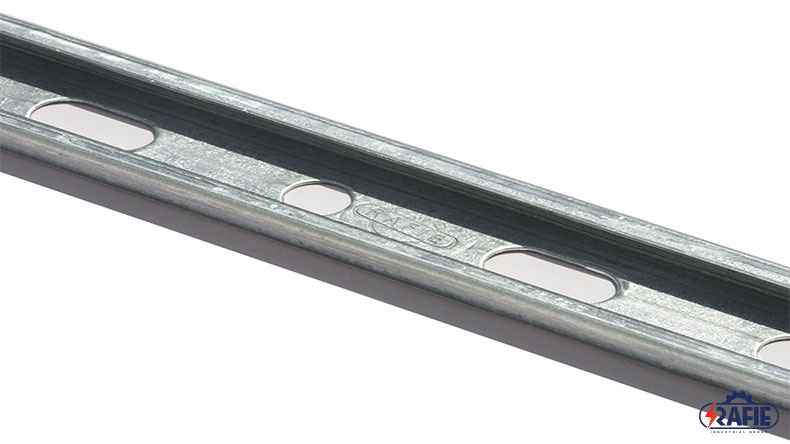
In industrial environments, to arrange and organize electrical conduits that must be positioned parallel to each other, using clamps alone is not enough. The C-channel rail, with its U-shaped cross-section, can be recognized as a practical and supportive option for clevis hangers, supporting the parallel placement of conduits. These rails are manufactured with galvanized material, high resistance, and ideal technical specifications to multiply the safety of industrial projects.
A C-channel rail is a metal component used in industrial and construction electrical systems as the main holder for clevis hangers. By eliminating the need for numerous drillings for individual conduits, this profile creates an integrated platform in which electrical conduits are placed at standard intervals and in a completely parallel manner using clevis hangers. By doing so, in addition to maintaining visual order in electrical risers, it prevents conduit sagging and the exertion of pressure on elbows and fittings. Due to their galvanized property, C-channel rails guarantee system safety against fire and environmental corrosion.
Due to the differing needs of various industries, these parts are manufactured and supplied to the market in a variety of dimensions. C-channels have very high resistance to external loading and moisture, and they can be produced in 2-meter and 3-meter lengths. The thickness of these parts can be changed according to customer requirements, but they are considered as 1.5, 2, and 2.5 millimeters as standard. If there is a need to increase the resistance and durability of C-channel rails, it is better to purchase them with higher thickness. However, under normal circumstances, to reduce weight and meet common standards, it is recommended that the dimensions of the C-channel be considered within the standard range and only in accordance with the need.
The price of C-channel rails is calculated based on the type of rail and the thickness of the plating applied to it. These rails are usually made of steel, and certainly the steel metal and its durability can affect the final price. Moreover, the daily dollar rate causes changes in the price of steel and can also change the price of C-channel rails. It is essential for customers to first determine the dimensions of these C-channels before inquiring about the price. Hot-dip galvanized plating increases the price of these rails, but for environments with high moisture sensitivity, it is recommended to definitely use top-grade hot-dip galvanized C-channel rails. For indoor environments, using cold galvanized or factory-plated rails is also sufficient and there is no need to be overly sensitive.
C-channel rails are usually made of steel with a galvanized coating so that they can have the best performance when installed in various projects. The galvanized coating of these products can be categorized into three types: hot-dip galvanized, cold galvanized, and factory galvanized.
Hot-dip galvanized: This type of equipment is first manufactured from steel sheets. After forming and cutting, the sheets are degreased and acid-washed to be cleaned. They are then placed into a molten bath of zinc metal and submerged in it. The thickness of the galvanized coating in this type of steel C-channel rail is usually 75 microns. This type of coating is considered among the most resistant C-channel coatings.
Factory galvanized: The galvanization process of the steel sheets is carried out before the production of these rails. Typically, galvanized sheets have a coating of 20 microns and have lower resistance compared to hot-dip galvanized. After being galvanized, they are used for manufacturing the C-channel rail.
Cold galvanized: The cold galvanized C-channel is a product that is manufactured using black steel. After preparing the rail and cutting it, acid-washing and preparation of the rail is carried out. Then the zinc coating is applied to the rail cold, without the need for placement in molten baths, at a thickness of 5 to 8 microns using a spray. This type of galvanized coating has less resistance compared to the two previous types.
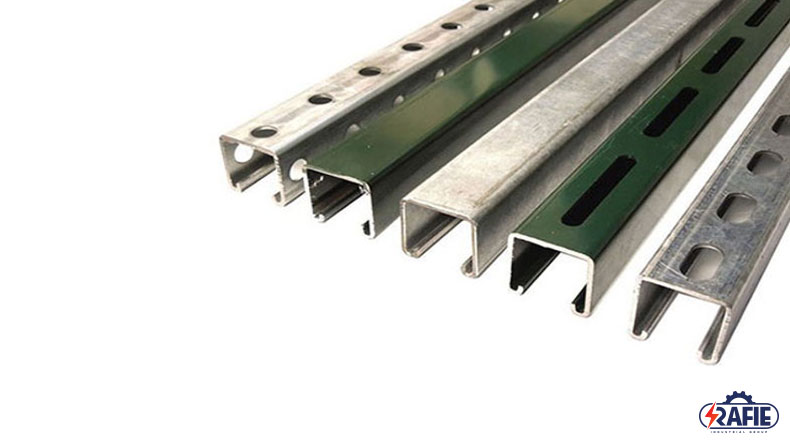
C-channel rails can be recognized as a type of galvanized support in electrical building services, manufactured in various lengths and widths. These products, which are made of steel metal and produced with a galvanized coating (in most models), can contribute to the durability of products due to their very important role in building and electrical installations. Whatever the price of these products is, they are economically viable and will help increase the durability of cables and organize them. Furthermore, it should be noted that the price of C-channel rails depends on various criteria, including the quality of the steel used, the thickness of the steel, the type of coating, and the daily price of steel. If you need to inquire about the daily price of C-channel rails, you can receive the exact price of these products based on technical specifications by contacting the experts at Rafi Industrial Group.
The C-channel rail is a component that, by creating a direct connection to the ceiling and wall area, is used as a holder for electrical conduits and cables. This rail has full compatibility with the galvanized clevis hanger and can be used to stabilize steel electrical conduits and properly guide cables.
On the body of C-channels, numerous holes are provided that allow their direct attachment to the wall and ceiling. It is only necessary to place these rails in the appropriate position using special screws and benefit from their performance in supporting electrical conduits. In summary, the most important applications of this product are:
Direct connection to walls and ceilings for cable support
Ability to connect to steel electrical conduits and maintain their stability
Creating a tiered support system for galvanized cable trays and cable ladders
Capability of implementation in projects with a high number of electrical conduits
Compatibility with Spit clamps, clevis hangers, and galvanized rods
Providing suitable stability for electrical conduits in industrial environments
Maintaining the stability of electrical conduits in residential projects and data rooms
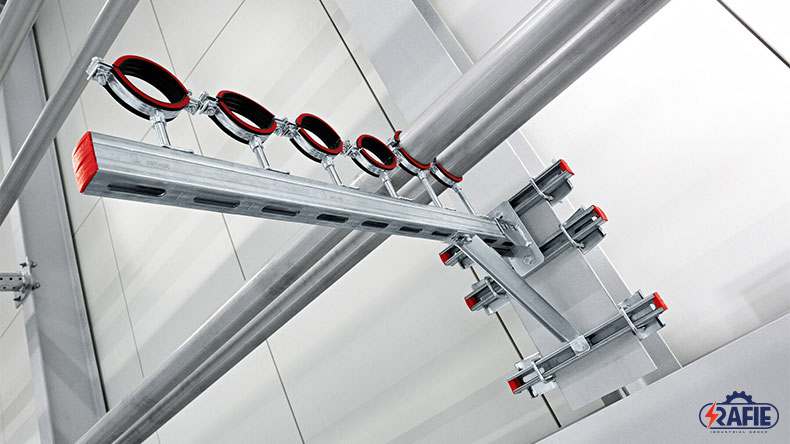
The C-channel rail is a component by means of which electrical conduits and cables, as well as various types of cable trays, can be kept stable at the heights of a structure. Although other complementary parts play an important role in creating support systems, the most important components are the C-channels, which are directly connected to the structure. The ideal advantage of C-channel rails is maintaining the safety of electrical conduit and cable installations, as well as the installation of other parts such as trays and creating support for cable ladders.
Because nothing is more important than providing safety for power distribution systems. If, for any reason, they collapse or detach from the structure, then compensating for the resulting damages will be very heavy. Therefore, engineers and support connection design experts, by manufacturing this product, strive to provide one hundred percent stability for the mentioned components. Thus, along with the valuable features and advantages that C-channels have, the issue of network safety is of the highest importance.
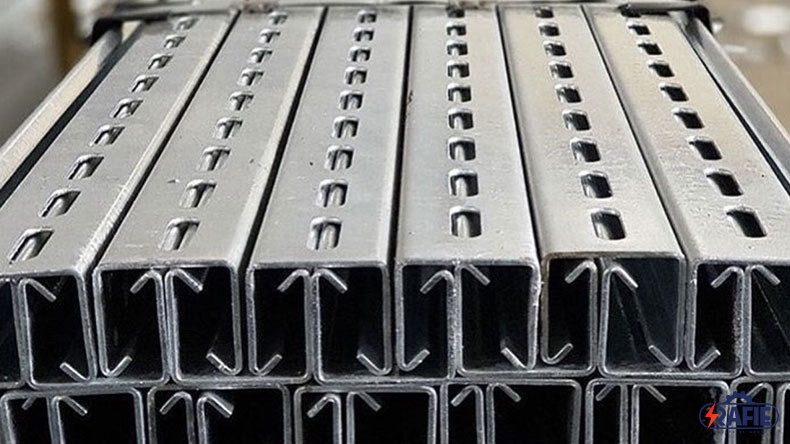
In the design and production process of C-channel rails, several stages of bending are used. As mentioned, these rails are made of galvanized steel sheets. However, to create a fully enclosed C shape, they must be bent multiple times by automatic equipment and machinery.
In general, there are six bends in the structure of the C-channel rail. Four of these bends are related to the edges of the C-channel, and two bends are located in the cross-sectional area. This bending ensures that other complementary parts, such as clevis hangers, can be placed inside the rail with high safety and complete stability.
The material of C-channel rails is usually made of high-density steel sheets.
These parts have a hot-dip galvanized coating that protects the metal structure against rust, corrosion, and oxidation.
They come in various sizes and can usually be produced in 1 to 3 meter lengths.
The standard thickness of C-channel rails is 1.25, 2, and 2.5 millimeters.
The most common cross-sectional dimensions and height of C-channel rails are 41×41 millimeters.
The design and structure of these rails is such that they are C-shaped to support various types of clevis hangers.
They are usually produced in punched and plain types.
The C-channel rail, using a cable tray support bracket, provides secure installation of trays on walls and ceilings and prevents cable vibration or displacement.

One of the very important applications of C-channel rails is their use in numerous electrical conduit and cabling projects along with various types of plain clevis hangers or insulated clevis hanger types. In fact, they can keep electrical conduits and cables completely stable on wall and ceiling areas. You can route and guide electrical cables and conduits using C-channel rails together with clevis hangers.
As you know, the structure of clevis hangers is designed in such a way that they have high compatibility and conformity with C-channel rails. In fact, when they are placed inside, they lock into it easily, and you can be confident that the electrical conduits and cables remain fixed in place within the structure. Considering that C-channel rails are designed and produced in maximum lengths of 3 meters, it is possible to use several clevis hangers on a single C-channel axis. By doing so, you can support several electrical conduits and cables in a single path line.
Spit clamps are very important parts used for holding electrical conduits in a suspended manner in various structures. These clamps are two-piece in structure and are connected to the ceiling area along with galvanized rods. The question may arise for you as to what role the C-channel rail plays in this and how it can be used together with a Spit clamp.
As mentioned, Spit clamps are responsible for suspending electrical conduits. However, these clamps must be supported by a secondary component. These components are exactly the C-channel rails. To create a support system using Spit clamps, C-channel rails, and galvanized threaded rods, it is first necessary to attach the C-channel rail to the ceiling area. Then, using threaded rods, you can directly connect various types of Spit clamps to the C-channel.
As a result, you have created a suspended support system for holding electrical conduits. Just like various types of clevis hangers, you can use several Spit clamps in a suspended manner along the axis of the C-channel.

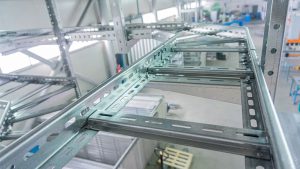
Supporting cable trays to prevent the transfer of excessive weight and bending under load is extremely important. One excellent and low-cost support method is the use of C-channel rails, which can bear part of the load from the cables installed on the C-channels. As shown in the image above, these rails can be placed as a support beneath the cable tray. To create this system, the following steps are typically followed:
Determining the rail dimensions: First, the exact size of the cable tray is determined so that the dimensions of the C-channel rail can be selected. Typically, the dimensions of the C-channel rail are slightly larger than the overall width of the cable trays.
Installing galvanized rods: To create a tiered connection with the C-channel rail, it is necessary to install galvanized rods of appropriate height on both sides of the C-channel rails. With numerous punch holes on the cross-sectional surface of the C-channel rails, connection to the rods can be made using a hex nut.
Attaching the rails to the ceiling or wall: Depending on whether the C-channel rail needs to be installed on the ceiling or wall, the galvanized rods must be installed in the appropriate location. The correct attachment of the rail to the ceiling and wall has a great impact on better support for the cable trays, so special attention must be paid to this.
Installing the cable tray: The cable tray is placed on the lower tier of the C-channel rail. If necessary, two or three cable trays can be placed in tiers on these rails so that the weight of the trays is well borne by the rails.
Final testing: Finally, the appearance, resistance, and overall design of the C-channel rail must be carefully inspected. Take seriously the full compatibility of the rail dimensions with the cable tray and the precise placement of the hex bolts in the threads to prevent them from becoming loose.
Dear customers can purchase a wide range of electrical conduit fittings with the highest manufacturing quality. The personnel and experts of Rafi Industrial Group always strive to ensure you have a successful and satisfactory purchase. For this reason, they provide you with the most comprehensive advice and specialized guidance at the time of purchase. You can contact this company to inquire about product prices as well as to make a purchase.
To receive free consultation, please fill out the form below. Rafi Industrial Group consultants will contact you as soon as possible.
To receive free consultation, please fill out the form below. Rafi Industrial Group consultants will contact you as soon as possible.