Rafi Industrial Group | Manufacturer and supplier of power cable support equipment


Electrical steel conduit is one of the main pillars in cable support systems. These conduits allow you to route electrical cables safely and efficiently in various parts of a building, such as walls, ceilings, and even in buried form. Given the high resistance of the materials making up these conduits, which are often known as hot-dip galvanized conduit, they can be used in harsh and high-stress environmental conditions without worrying about structural changes.
Customers usually have questions about the technical specifications of steel conduits, such as their size, thickness, weight, and anti-rust coating. In addition, the price of these products is also among the important priorities of buyers.
In this article, we will precisely examine these features so that you can make an informed decision for purchasing electrical steel conduit. So, if you are looking for precise and practical information, do not miss the continuation of the article! ⚡
Electrical steel pipe is a round cross-section pipe that allows the transmission of wires and cables in a safe path without physical pressure. These conduits are made from resistant, high-quality steel, and their main function is to protect cables against impact, pressure, moisture, and corrosion. In addition, a galvanized coating is also used to increase the resistance of these conduits to corrosion and rust, so that their performance under environmental conditions improves.
Installing electrical steel conduit, in addition to increasing safety, also ensures the order and aesthetics of the cabling path and provides the possibility of easy expansion and maintenance of the electrical system. Therefore, these conduits have wide application in projects such as factories, sheds, commercial buildings, and power plants. Resistance to heat, mechanical pressure, and environmental conditions gives these conduits a long service life, increases the safety of the electrical wiring system, and prevents damage to the wires and cables, whose correct function is essential for a large environment and specific equipment.
Contractors and engineers always face the challenge of purchasing electrical steel conduit suited to the project’s needs at an affordable price. Steel is inherently sensitive to moisture and rusts when exposed to water and moisture. For this reason, it is usually not implemented alone and without a coating; however, it can be implemented with a galvanized coating or other moisture-resistant coatings. To further guide buyers, we introduce the types of electrical steel conduits.
Cold galvanized electrical steel conduit is an affordable choice for environments with zero humidity. To produce this type of conduit, the electro-galvanization method is used. Specifically, a combination of zinc and diluting solutions is used to spray onto the conduit. The conduit surface is sprayed to the extent that a thickness of 15 microns is created. Cold galvanized steel conduits have high flexibility, a reasonable price, and a very smooth and polished surface, and their color is shiny and bright.
Another type of electrical steel conduit available in the market is hot-dip galvanized conduit. This type of conduit, also known as hot-dip deeply galvanized conduit, can be used for environments with very high air humidity and provides extraordinary efficiency. This type of electrical conduit has high resistance to moisture and rust. Its production process is also in immersion form, meaning the conduit is immersed in a molten zinc bath so that a layer of zinc with an ideal thickness is deposited on the conduit. In this method, only the outer part of the conduit is uniformly galvanized.
Factory galvanized steel conduit is another type of steel electrical conduit that contains zinc, but its thickness is lower than conduit plated by the hot-dip galvanizing method. Instead of being plated after production, this type of conduit is manufactured from the very beginning using factory galvanized sheets. For this reason, the galvanized sheets must be cut and formed in the factory in such a way that a suitable conduit for power distribution is made. The main advantage of this type of electrical steel conduit is having a galvanized coating on both the inner part of the conduit and its outer part.
Another type of electrical steel conduit available in the market, which is mostly used in modern spaces due to its dark appearance, is this type of conduit. Black steel conduit is designed without any galvanized coating, and that is why its color is black and dark. It can be used for false ceilings and visible surfaces. However, it is not possible to use this type of conduit underground and in places exposed to corrosive and erosive factors. In fact, steel conduit does not have a moisture-resistant coating and has high sensitivity to environmental water and moisture, but it can effectively resist impact, cutting, and applied pressures and does not transmit these factors to the wires placed inside them.
One of the most important features of an electrical steel conduit is its weight, which plays a key and very important role in its performance. The weight of the conduit must be moderate; because if it is excessively high, it makes the installation process difficult, and if it is low, it indicates the low quality of the electrical conduit. To calculate the weight of electrical steel conduits, you can proceed according to the following formula:
Weight of electrical steel conduit = (Outer diameter – Thickness) × Conduit length × Thickness × 0.0246
According to this formula, the conduit length, thickness, and outer diameter of the electrical steel conduits have a direct impact on their weight. In this regard, customers should first inquire about their weight from the seller before purchasing these products so that they can safely go through the conduit installation stages.
With its high variety, electrical steel conduit can be used in all projects and various conditions. These conduits have excellent strength, durability, and protective properties and provide a wide range of applications:
Wiring protection: The main application of these conduits is the physical protection of electrical wires and cables against impact, moisture, dust, and other environmental damage.
Wiring routing: These conduits allow the organized and safe routing of wiring inside walls, ceilings, floors, or in a surface-mounted manner.
Installation of electrical equipment: In some cases, these conduits are used for installing and connecting junction boxes, electrical panels, and other electrical equipment.
Industrial and commercial applications: In environments where there is a need for greater strength and resistance to harsh conditions, electrical steel conduits are the preferred choice.
The correct installation of electrical steel conduits is very important to ensure the safety and efficiency of the electrical system. Before installation, care must be taken that cold galvanized steel conduit is suitable for indoor environments and hot-dip galvanized steel conduit is suitable for outdoor environments. The general installation steps include the following:
Route planning: First, the exact path of the conduits must be determined according to the building plans and the location of the electrical equipment. Factors such as physical obstacles, visual aesthetics in the case of surface-mounted installation, and access for maintenance must be considered.
Cutting the conduits: The conduits must be cut to the required sizes using appropriate tools such as a pipe saw or a special cutter. The sharp cutting edges must be smoothed using a file or a special tool so that they do not damage the wires during passage.
Bending the conduits: In many cases, the conduits need to be bent to pass around corners or change direction. This must be done using a conduit bender tool and with precision to prevent the conduit from breaking or collapsing. The bend angle and radius must comply with the project’s standards and specifications.
Connecting the conduits: The conduits are connected to each other and to the boxes and electrical panels through special fittings. The most common fittings include elbows, couplings, conduit caps, etc.
Pulling the wires: After the complete installation of the conduits and ensuring their strength and the absence of obstacles inside them, the electrical wires are pulled through the conduits. A fish tape is usually used for this to ensure that the wires pass through the conduits appropriately.
Final connection: The wires are connected to the electrical equipment such as sockets, switches, and lamps, and the final electrical connections are made.
Choosing electrical steel conduit and installing and implementing it in various projects can bring many advantages. Steel, as one of the most resistant metals, can not only show good resistance to impact and applied pressures but also, under specific conditions, if it has a galvanized coating, has high resistance. These conduits have a very long service life and, with appropriate fittings, can prevent moisture ingress and short circuits in common facility wiring.
Electrical steel conduit makes wires resistant to damage from vermin and can increase their resistance to fire. Using these conduits with appropriate thickness does not allow sensitive wires and cables to be exposed to breakage or severe physical impacts. To achieve the maximum advantages of electrical steel conduit, it is essential to use them with the appropriate thickness and an anti-rust and resistant coating. In this case, the probability of damage to them is minimized. Among the most important advantages of electrical steel conduit, the following can be mentioned:
Very long lengths in various surface-mounted and flush-mounted projects
Great durability in electrical installations
Excellent resistance to the entry and penetration of vermin
Waterproof and prevention of short circuits between electrical wires
High resistance to common fires
Maximum resistance to breakage and physical impacts
High resistance to UV rays and usable in a surface-mounted manner
Reusable several times
Protection against electromagnetic interference
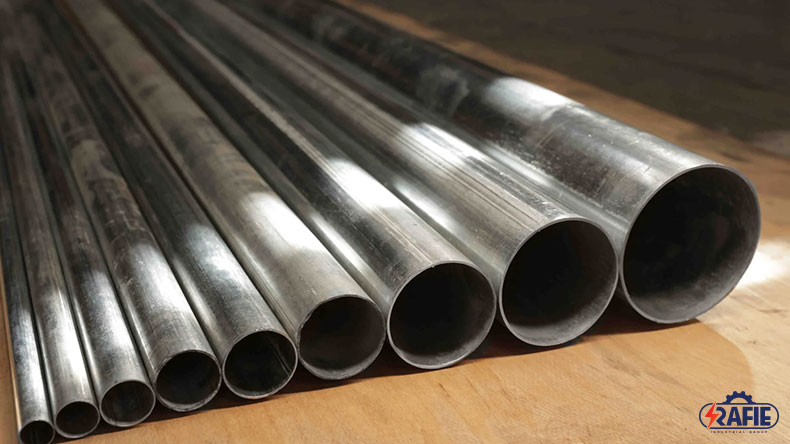
One of the most important matters to consider in electrical installations is quality and durability. In electrical installations, choosing the right conduit to protect wiring is so important that special attention must be paid to it. Electrical steel conduit, due to its very high mechanical resistance, shows good resistance to impact and applied pressures. In addition, it can also demonstrate very good resistance to potential fires. However, you should note that electrical steel conduits are heavier than PVC and polyethylene conduits and can also be prone to rust.
In contrast, PVC conduits are very lightweight and cheap and are also used as a very suitable electrical insulator. Installing this type of conduit is much simpler and can also show high resistance to corrosion. However, PVC conduits do not have high resistance to heat and may deform at high temperatures. Polyethylene conduits can be used in complex paths. These conduits are anti-corrosion and lightweight, but they are highly sensitive to UV rays and should not be used exposed in surface-mounted projects. Most electrical conduit fittings are made of metal and are more compatible with electrical steel conduits. Therefore, the installation, execution process, and final durability of electrical steel conduit are higher compared to other products.
This type of hot-dip deeply galvanized conduit is classified in terms of size based on the PG standard and in various gauge numbers. The information we provide regarding the size of these conduits is based on DIN-40430 standards.
Therefore, if you observe minor differences in other standards, it is related to this very matter. Electrical steel conduits are classified into the following types:
| Conduit size (inches) | Inner diameter (mm) | Outer diameter (mm) | Wall thickness (mm) |
|---|---|---|---|
| 1/2 | 16.0 | 21.3 | 2.0 |
| 3/4 | 20.0 | 26.9 | 2.3 |
| 1 | 25.0 | 33.7 | 2.6 |
| 1/4 1 | 32.0 | 42.4 | 3.0 |
| 1/2 1 | 38.0 | 48.3 | 3.2 |
| 2 | 50.0 | 60.3 | 3.6 |
| 1/2 2 | 63.0 | 73.0 | 4.0 |
| 3 | 75.0 | 88.9 | 4.5 |
| 4 | 100.0 | 114.3 | 4.8 |
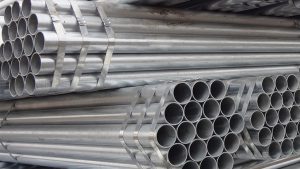
When the design and manufacturing stages of the electrical steel conduit are fully completed, it is necessary to arrange them with high organization. In fact, this has numerous advantages. Firstly, it prevents damage to the conduits during transportation. On the other hand, a high number of conduits can be better managed. Usually, conduits of the same size are placed in one package, and all steps for separating and segregating non-identical conduits will be carried out.
Bundles are used for arranging and packaging the conduits. Bundles allow a number of conduits to be placed on top of each other and formed into a package with a strong strap. These measures are the only things that can be done to provide maximum physical protection for the conduits. Another very important measure, vital during the transportation of the conduits to the project site, is the use of a plastic end cap for the electrical conduit. Of course, a plastic cap for junction boxes also exists, and these two differ from each other in terms of design.
However, the important objective pursued is to prevent foreign objects from entering the conduit and to block the passage. Also, fluids and dust will not penetrate inside the conduits, and the integrity of the conduit will be maintained both from its external and internal parts. Conduit caps are part of the accessories that manufacturing companies and groups will definitely use. When customers receive the packages of electrical steel conduit, they are completely intact and sound, and they will use them in the project with high safety.
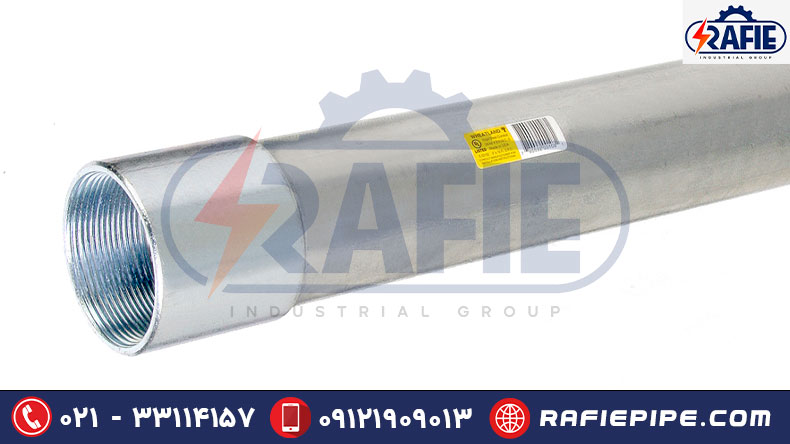
One of the very important and fundamental advantages that can be mentioned regarding electrical steel conduit is that if, in some cases, it is necessary to route electrical cables from the power source into the structure and the cabling path is also from the floor of the structure, these conduits can route thick cables in a substructure manner. The reason for this is also due to the galvanized coating on these conduits.
Of course, various processes are used to strengthen these conduits, the most important of which are hot-dip galvanized coating, cold galvanized coating, and, in some cases, painted coating. However, we must consider that not every conduit can be installed inside the structure. For example, if you want to place black conduits in a buried form, you may witness their rust after some time. On the other hand, currently, hot-dip galvanized electrical steel conduit is the most resistant conduit that can be used in various projects. Of course, another type has also been produced, which is stainless steel electrical conduit, and they have completely different characteristics.
Electrical conduits are not only in the form of steel conduits. Usually, there is a relatively high variety for these conduits, which includes polymer conduits or fireproof conduits, cold-bend conduits, followed by stainless steel and hot-dip and cold galvanized conduits, and colored conduits. It is your project’s conditions that determine which of these conduits will be suitable for supporting the cables. In some cases, it is possible that with a smaller budget, you only need cold-bend fireproof or polymer conduits. Consequently, experts try to receive more comprehensive information about your project to introduce the best conduit. The price of galvanized conduit also depends on its structure. Whether it is a hot-dip or cold galvanized type, the price is not the same.
If you look at the diverse fittings of various types of conduits, whether galvanized or black conduits, you will see that they are all designed in a threaded form. That is, they are threaded on the inside, and the outer part of the conduits is also threaded.
These are connected to each other by screwing, and you can complete the paths and networks you have drawn up in the form of a plan before starting work. However, we must examine why welded fittings are not used and what the reason for this is. The most important reason is that you may want to change the conduit routes.
Therefore, it must be possible to open the connection points and conduit branches. Hence, if you want to use the welding process on the conduits, firstly, this is not logical, and nor can the project be completed within a specified time. Furthermore, the elements placed inside these conduits are electrical cables, not fluids. So, even the most complex networks can be created with these same threaded fittings.
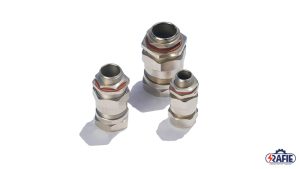
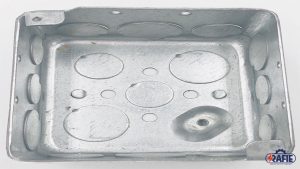
One of the special features of electrical steel conduit is that, along the cable routing path, they can be directly connected to junction boxes. As you know, the junction box is responsible for branching electrical cables. To connect the electrical conduit to these boxes, other accessory parts such as couplings and brass bushings are used.
Specifically, first, the conduit opening is brought close to the box, and the steel coupling will be screwed onto it. Then the brass bushings are passed from inside the junction box and through the punch or hole in the body so that they can be screwed onto the steel coupling outside the box. This work process results in a firm connection of the conduits to the boxes and electrical panels.
After completing the purchasing stages for the standard sizings of electrical steel conduit, it is necessary to have precise planning for installing these conduits. Generally, electrical conduits can be installed at various points. You may want to use these conduits in a flush-mounted manner inside the structure. Due to the conduits being galvanized, there is no obstacle to using these conduits within the internal fabric of the structure.
Their next application is in open environments exposed to the ambient atmosphere. Again, under such conditions, no type of structural damage occurs to these conduits, because they have a complete anti-oxidation or corrosion coating.
Another path where electrical steel conduit is installed in the structure is at the heights of the structure. In fact, you can install these conduits at high points of the structure with appropriate fittings. However, in this regard, we need a series of connecting parts, the most widely used of which include the following:
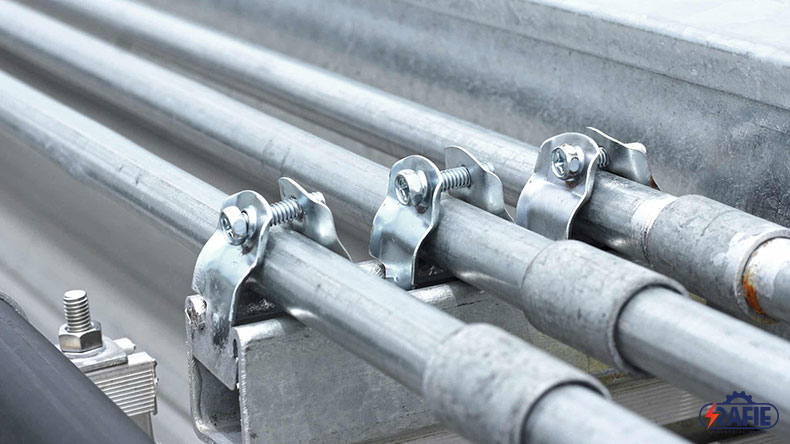
One of the most important parts used for installing and connecting electrical conduits at the heights of a structure is the Spit clamp. These clamps are also known as two-piece clamps and, due to their various sizings, have the ability to support various types of electrical conduits. On both sides of this clamp, there are two screws, and by opening them, the installation operation can be carried out. At its top part, there is also a screw point for connecting the galvanized rod, and with this technique, these clamps can be directly connected to the C-channels installed on the ceiling.
Clevis hangers for electrical steel conduit are considered among the most common structural fittings. These clamps require complementary parts for the connection operation, which are exactly the C-channels. These C-channels are usually also known as clevis hanger rails. Specifically, a high number of clevis hangers are placed inside these rails, and as a result, you can place the steel conduits one after another alongside each other.
To use the clevis hanger and also the Spit clamp, you must definitely have a C-channel. In such a way that you cannot use the other two introduced clamps without this part. Their structure is such that they have a C-shaped cross-section and, by means of the punching performed on their cross-sectional surface, are directly connected to the ceiling or walls. These channels are also used as a support system for electrical conduits.
As mentioned, galvanized rods are usually used together with Spit clamps. These rods are completely made from steel material and are threaded along their axis. They can easily be cut using special tools such as a cutter, so you can adjust their height from the ceiling area.
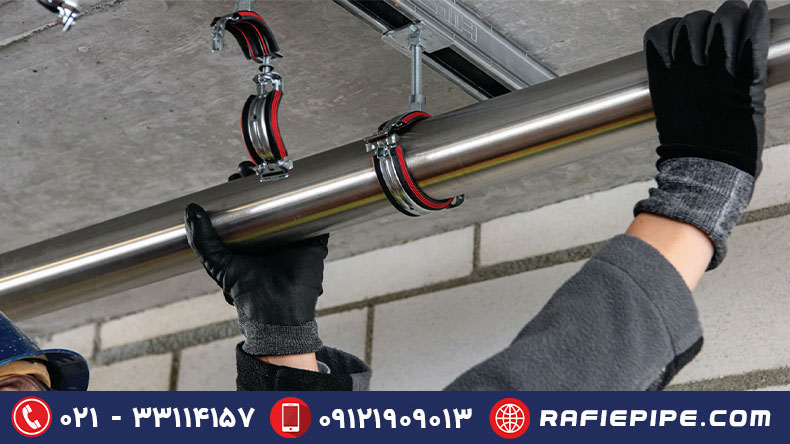
There is a wide variety of equipment for supporting electrical cables, including cable trays, cable ladders, and PVC conduits. However, the main question is: when should we choose electrical steel conduit for routing, guiding, and supporting electrical cables? Is there a specific rule about this? Or can these conduits be used in all projects?
As a general rule, if we want to make a fundamental comparison between the mentioned equipment, trays and ladders are designed and manufactured to carry and route a high number of cables in one place. Whereas steel conduits can only route a limited number of cables along a single path. Furthermore, environmental conditions also influence the selection of support equipment.
Usually, electrical steel conduit has the capability to transmit electrical cables even in a buried state. However, trays are mostly installed on the structure at heights. Electrical steel conduit, due to the diverse fittings it has, can be employed in structures with specific architecture where extensive changes of direction are needed.
In summary, the number of cables, the type of structure, and the level of environmental stresses determine the choice of electrical conduit, cable tray, or cable ladder. Therefore, it is better to consider all variables before using various sizes of steel conduits and trays.
Both types of conduit, i.e., black electrical steel conduit and galvanized steel conduits, are designed and manufactured to support electrical cables. However, the type of environment in which these conduits are used is not the same. Currently, galvanized conduits are the most resistant conduits, so their use is recommended in extremely humid and high-stress environments.
Black steel conduits are for applications where there is not much stress in the environment. Therefore, there is not much necessity to seek to purchase galvanized conduits by spending high costs. So, we must assess the environmental conditions for choosing these conduits. The most important difference, as mentioned, is the type of protective coating. Black conduits are coated using some epoxy paint derivatives.
These paints can, to some extent, prevent chemical processes or rust in the metal over a specific period. However, their resistance level is lower than hot-dip galvanized coatings. In contrast, galvanized electrical steel conduit is coated using molten zinc. It is completely natural that they can have a longer service life and also that environmental conditions do not negatively affect them.
These are considered the main differences between these two types of conduits, because in terms of fitting type and sizing, they are identical, and the weight of the steel conduits in the mentioned types does not differ much from each other. Furthermore, they have the same packaging and are prepared in bundled form. In both of these conduits, the seam-welding method is used for manufacturing, and they are made from a single steel sheet.
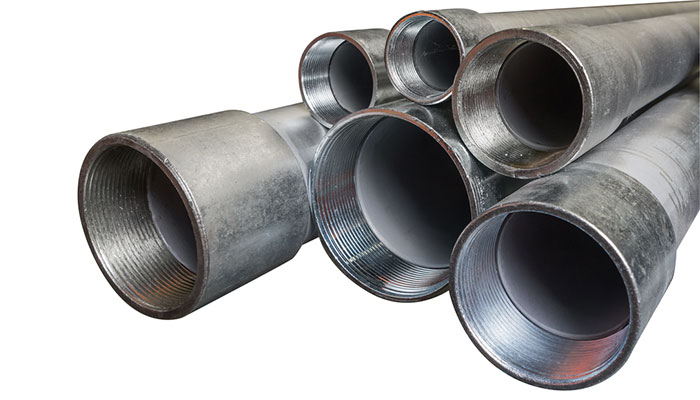
For electrical steel conduits to be used in a cabling network, they need conduit fittings. Generally, no type of conduit network can be constructed without fittings. Conduit branches are designed and manufactured in maximum lengths of three meters; therefore, if we want to install conduits along a path of several meters or create a change of angle in the network, we will have a fundamental need for fittings. Given the various types of these widely used parts, we will explain each separately in the following section. When purchasing electrical steel conduit, we must also pay special attention to their fittings.
Elbows are among the most widely used connecting parts for electrical steel conduit. These accessories can create a 90-degree change of direction. Of course, there are also 45-degree elbow types used for specific projects. These fittings are screwed onto the conduit via internal threads and can connect conduits of the same size to each other.
Couplings are a simple metal cylinder that is threaded or tapped on the inside. These can extend the conduit path in a single or uniform direction. For example, if you want to install conduits along a straight path of several tens of meters, couplings come in handy.
Tees, as their name suggests, can connect three electrical steel conduits of the same diameter to each other. Regarding cross parts or cross fittings, 4 conduits will have the ability to be connected at one point.
Covered fittings are often also known as conduit bodies — a part that can connect electrical conduits to each other in different directions. Due to having a screwed cover on these parts, the management of cable connections will be easier.

For electrical steel conduit, or galvanized electrical conduit, to resist natural factors such as environmental weather, it must definitely have a protective coating. Primarily, these coatings make the conduits rustproof. Chemical processes such as oxidation, which can cause discoloration and corrosion, are among the most destructive factors that completely destroy the conduits.
However, the main question is: what is the type of coating on steel conduits? Usually, after the design and overall formation of the conduits, in a separate process, they are placed inside a chamber of molten zinc. This molten material has a temperature of about 500 to 600 degrees Celsius.
At such a temperature, the adhesion strength of the zinc compounds is certainly extraordinarily high, and any metal placed inside the zinc chamber will be completely coated. These conduits, depending on the type of strengthening process, differ from types of cold galvanized conduit as well as black steel conduit. However, in general, the hot-dip galvanized coating has the highest degree of resistance intensity.
The price of electrical steel conduit depends on several important factors. The first issue is related to its size. As the size increases, the amount of steel material consumed for constructing and manufacturing the conduits increases, and you need to pay a higher cost to purchase larger-sized conduits.
The next factor is the type of strengthening coating on the conduits. Generally, two important types of strengthening processes are followed in electrical conduits, which include hot-dip galvanizing and cold galvanizing.
Conduits strengthened by the cold galvanizing method have a lower price than hot-dip galvanized types. Therefore, it is your project type that determines which of these conduits to use.
To purchase various cable support equipment at the most reasonable price, you can contact the consultants and experts of Rafi Industrial Group. Also, a series of specialized consultations regarding the project you are working on have been prepared for you, and by utilizing them, you can advance the process of your project with high quality.
To receive free consultation, please fill out the form below. Rafi Industrial Group consultants will contact you as soon as possible.
To receive free consultation, please fill out the form below. Rafi Industrial Group consultants will contact you as soon as possible.