Rafi Industrial Group | Manufacturer and supplier of power cable support equipment


The flexible conduit clamp is a structural retaining element designed for the mechanical stabilization of metal and non-metal flexible conduits on vertical or horizontal surfaces. The main function of this part is to prevent sagging and unwanted vibrations along the electrical conduit installation path with metal flexible conduit. By creating a firm connection between the conduit body and the supporting structure, the flexible conduit clamp, while maintaining the flexibility of the system, will prevent tensile and mechanical stresses on the conduit seams, fittings, and glands. All of these key advantages of using these clamps are focused on their high quality and compliance with technical and engineering standards for their manufacture.
Flexible conduit clamps are used in various industries, including electrical wiring, CCTV installation, and ventilation systems. Due to their high resistance and suitable flexibility, these clamps can safely and efficiently connect flexible conduits to structures. Also, using these clamps in industrial projects reduces maintenance costs and improves system performance.
Using flexible conduit clamps is recommended for several reasons. One of the main advantages of these clamps is their high flexibility and light weight, which simplifies installation and transportation. This feature is especially useful in confined environments or for projects that require greater flexibility. In addition, due to the resistant materials from which they are made, flexible clamps are resistant to adverse environmental conditions such as moisture and chemicals.
To choose the right clamp, attention must be paid to the type of project and its specific requirements. Flexible clamps are offered in various types, such as coated clamps and roll-type clamps with separate locks. Coated clamps are made of materials such as PVC or polyethylene and are especially suitable for sensitive applications such as the transmission of water, gas, and chemicals. On the other hand, roll-type clamps with separate locks are used to connect several flexible conduits together or to other larger installations.

One of the important points in selecting flexible clamps is their resistance to rust and corrosion. Especially in humid environments or those exposed to chemicals, using galvanized clamps or those with protective coatings can increase the useful life of the conduits and related systems. In addition to high physical resistance, these clamps are also resistant to chemical factors, a feature that significantly reduces maintenance and repair costs.
To choose the right clamp, it is necessary to become familiar with the different types of flexible conduit clamps. Metal clamps, polymer clamps, and coated clamps are among the available options. Each of these types is designed for specific applications. For example, metal clamps, due to their high strength, are suitable for heavy industrial environments, while polymer clamps, due to their light weight and greater flexibility, are preferred for smaller environments and lighter projects.
One of the advantages of using flexible clamps is the reduction of overall project costs. Due to their simple and quick installation, these clamps reduce execution costs. Also, due to their durability and long service life, they do not need frequent replacement, which also results in savings in maintenance and repair costs.
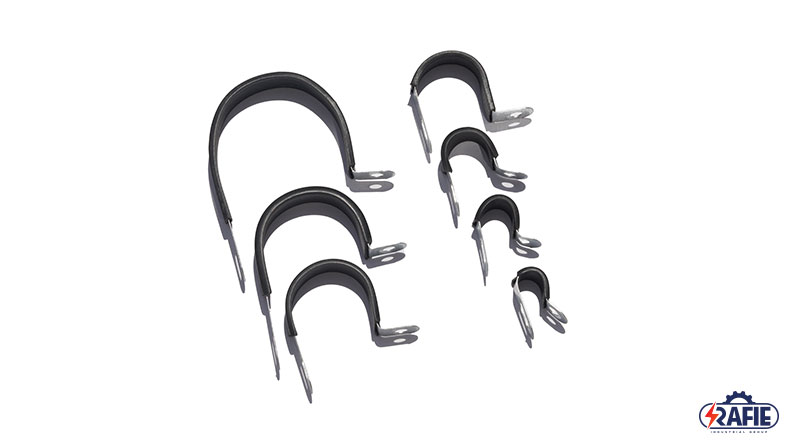
As you can see in the images, the flexible conduit clamp has a circular structure. The material of this connecting part is made of fully galvanized alloys. Therefore, you can be confident that this clamp has ideal performance both in terms of physical resistance and chemical resistance. Physical resistance means that external forces and pressures cannot cause deviation, bending, or breakage of the clamp body.
Its chemical resistance is such that in humid environments, it does not suffer from rust, corrosion, discoloration, or oxidation. There are various methods for galvanizing the conduit clamp, including hot-dip and cold galvanizing. In open environments, it is usually preferred to use the hot-dip galvanizing method to coat the clamp.
To support and hold the coated flexible conduit, an elastic insulator is placed in the inner part of the conduit clamp. The function of this insulator is to prevent damage to the body of the flexible conduits. As a result, no matter how tightly you secure the flexible conduit clamp in a structure, the force and pressure applied to the body of the flexible conduits will practically not cause denting or damage to the conduit body. In the base part of the clamp, there are also two holes for tightening the connection. This type of clamp, similar to a base-mounted pipe clamp, provides greater safety during installation on the structure and guarantees the ability to keep the conduits fixed under various conditions. In the next section, we will introduce all the available sizes of these clamps.

As you know, various types of flexible conduits have very diverse sizings. Each of these conduits is suitable for supporting a specific type of cable. For this reason, you cannot use one type of clamp for all sizes of flexible conduits. The sizes produced for flexible conduit clamps are in gauge numbers 6, 8, 10, 13, 16, 18, 20, 26, 28, 32, 36, 45, and 51.
Higher gauge numbers of this clamp naturally have the ability to support conduits with larger diameters. For this reason, we always emphasize that you should have very high precision in purchasing the correct sizings of this connecting part. For example, gauge number 51 of the conduit clamp has a length of 73 millimeters from the upper curved part of the clamp to the base. This clamp is capable of supporting various types of flexible conduits with an outer diameter of 48 millimeters to 60 millimeters.
Also, its smaller type, identified by gauge number 6, has a length of 30 millimeters and is suitable for size 6 conduits. Gauge number 16 clamp is for size 13 conduits, and size 18 clamps are also suitable for size 16 conduits. The remaining sizes of flexible conduit clamps similarly support a specific type of conduit. All information is available in full detail at the time of purchase and in the product catalog, and the sales experts will provide the necessary guidance regarding your project type based on the information received.
They can be easily connected and detached, and you can connect the conduits to the structure with greater speed.
The insulation material of the flexible conduit clamp is PVC, which has suitable elasticity and can provide a protective coating for the conduits.
They are designed and manufactured in various sizings, and there is one type of clamp for each conduit size.
The insulation of these clamps has high thermal resistance and does not detach from the main body of the clamp against environmental temperature fluctuations.
Due to being domestically manufactured, these parts have a very affordable price, and you can purchase a high number of these clamps for your cabling projects using flexible conduits.
Given that these clamps have a relatively low weight as well as standard controlled dimensions, a high quantity is usually considered for their packaging. For example, you can purchase size 16 flexible conduit clamps in packs of 100. Of course, this packaging exists for the relatively smaller sizes of these clamps. However, as the size increases, you can also order their quantity as desired.
Many CCTV camera installation projects in commercial structures are so vast and extensive that in some cases, you may need a high number of these clamps. Therefore, an accurate assessment of the required number of these clamps will be carried out by an expert.
Rafi Industrial Group, as a leading manufacturer, offers the most diverse sizes of flexible conduit clamps along with various types of cable glands and flexible conduits with very high quality to customers. In terms of structure type, these clamps are designed and manufactured in compliance with international standards. For this reason, in terms of connection type, they can provide high safety for numerous industrial electrical projects. You can contact our experts to learn about their exact price as well as other technical details.
To receive free consultation, please fill out the form below. Rafi Industrial Group consultants will contact you as soon as possible.
To receive free consultation, please fill out the form below. Rafi Industrial Group consultants will contact you as soon as possible.