Rafi Industrial Group | Manufacturer and supplier of power cable support equipment


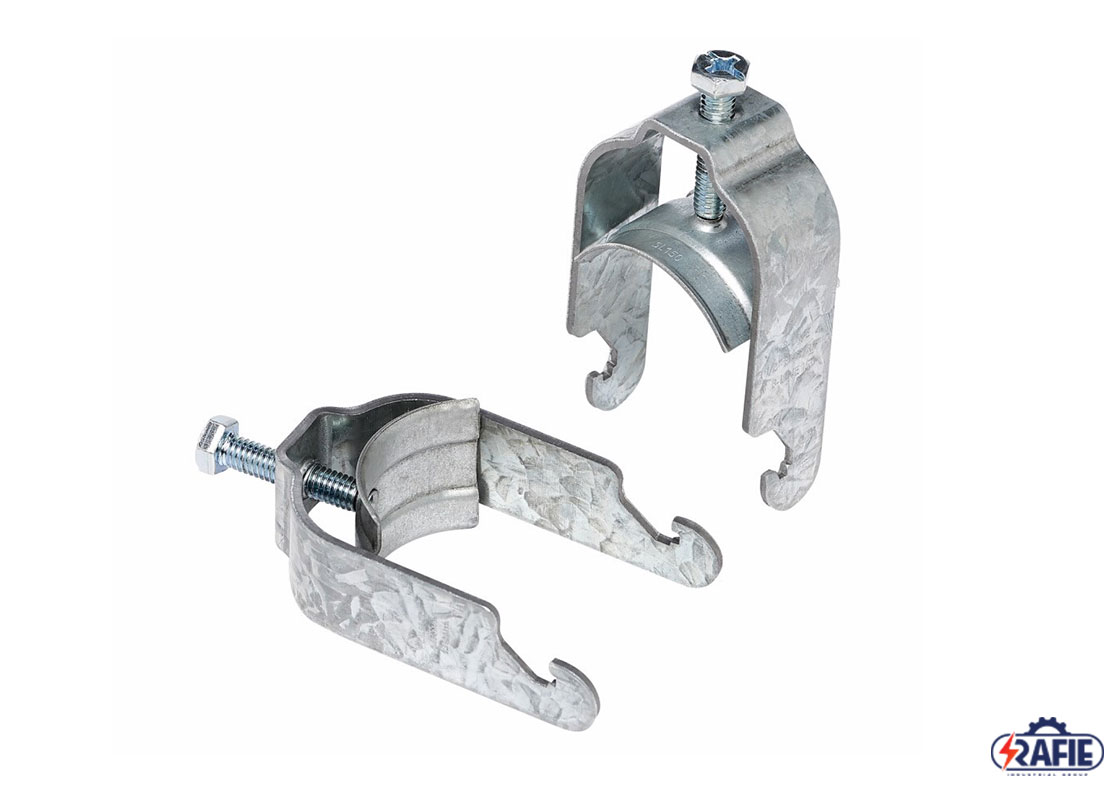
The clevis hanger is one of the key and essential components in electrical conduit and cable routing systems, used to create secure and stable connections in various structures. Due to their special design and U-shaped structure, these components effectively route cables and conduits along wall and ceiling paths. With connections that are resistant to pressure and vibration, clevis hangers ensure high safety and strength for the installation of electrical systems and industrial pipes. To learn more about the features and advantages of this connector, continue reading the article.
The clevis hanger (strut clamp) is considered one of the vital and strategic components in cable management and industrial facility support systems. It is specifically designed for securing steel pipes (PG and conduit) and high-voltage cables onto C-channel rails. The engineering structure of this part consists of two separate jaws made of factory-galvanized or electroplated sheet metal, which have hook-like tabs at the end for mechanical engagement with the inner edges of the rail. This intelligent design allows the physical load of the pipe to be evenly distributed along the rail and prevents the pipes from deforming due to weight or harmonic vibrations.
The technical function of this two-base metal clamp is based on a bolt and nut connection mechanism. By applying vertical pressure, it simultaneously tightens the jaws against the pipe body and locks the clevis bases into the rail groove. The use of hot-dip galvanized coatings in the production of these clamps provides high corrosion resistance in acidic and humid environments. This feature, along with the ability for quick adjustment and repositioning along the horizontal axis of the rail, has made the clevis hanger an unrivaled choice for refinery, power plant, and industrial shed ceiling projects involving extensive cable routing.
The clevis hanger, as a connecting part, must be designed and manufactured from the strongest and most durable metals. Since some types of these connecting parts are designed and built to support electrical conduits, they must have a strong body to hold these conduits stably at height within a structure.
Using soft metals and other alloys with weak structures for manufacturing these clamps is not very logical, because in that case, there is no guarantee for securing and holding the pipes and cables. Therefore, designers and manufacturing engineers use fully galvanized stainless steel or steel alloys to make these clamps. The movable lever part, as well as the internal section of the clamp, are all made of stainless steel or galvanized steel.
They do not lose their overall form when pressure and force are applied. Therefore, they are the best parts for holding electrical conduits and cables. To use these clamps correctly, you must place them inside C-channels. Due to the screw-like lever at the top of the clevis hanger, you must first fully open the screw so the pipes can be placed inside the clamp.
After opening the screw, you can tighten it again. Its operation works in such a way that tightening the screw creates additional force in the retaining lever, which keeps the pipes and electrical cables fixed. Furthermore, by opening and tightening the screw, you can also adjust the height and the grip diameter of this type of electrical conduit fitting.
There are various classifications for clevis hangers. Their structure and design type are the same, but there are some minor elements that differ, which makes their use different for cables and pipes. That is, some clamps are for pipes and other types are for cables. Extensive information will be provided on this subject so that you fully understand how to select this rail clamp and use it in your conduit and cable routing project. If we want to compare clevis hangers based on their material and structure, we can provide the following categories:
The constituent materials of stainless steel clevis hangers are iron metal and the elements chromium and nickel. Approximately 11% of the stainless steel material is chromium, which gives these metals their very high resistance. A certain percentage of carbon is also present in this type of structured alloy, which turns them into a hard and strong component. Stainless steel metals are used not only in industry but also in many different fields, even medicine. If we want to provide a general comparison among the introduced metals, stainless steel is harder and more resistant in every respect, but its price is much higher than other types.
Considering the characteristics of aluminum material used in clevis hangers and the fact that they do not have very high usage in high-tension industries, it must be said that they are still produced. However, if we want to use a clevis hanger in a high-stress environment and work complex, the best choices are stainless steel types and galvanized steel sheets. In other projects, however, aluminum clamps may also be used. Naturally, aluminum alloy does not have the resistance and hardness of stainless steel metals and galvanized steel sheets. But its most important advantage is the low product price, which can result in substantial budget savings if a large quantity is purchased.
Among the stainless and aluminum types, hot-dip galvanized steel clevis hangers have higher sales due to their high resistance and strength, as well as their reasonable price. The sheet material of these clamps is steel, and due to the galvanized coating, they are completely corrosion-resistant. Moreover, thanks to their controlled thickness, they are entirely lightweight and easy to use. The galvanizing process is generally performed on steel and carbon alloy materials, because steel does not deform or soften structurally at high temperatures, making it an ideal option for galvanizing.
Models that differ from each other based on material often have the same appearance and operating mechanism. However, insulated models, non-insulated models, as well as types without a lever or adjusting screw, are among the most widely used clamps and are employed frequently. Leverless screw models are often used for hard steel pipes.
On the other hand, simple models with plastic or polymer, as well as clamps that have an adjusting screw, are ideal for cables. It should be kept in mind that each clamp has its own specific use, and the executive teams must make the right decision in selecting and installing them in the network. In this article, these types of clamps will be introduced further to reach a complete understanding.
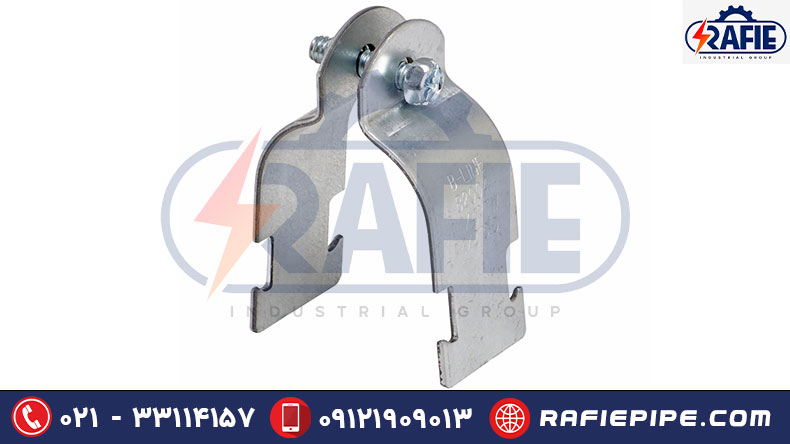
One of the most important points to prioritize when using plain clevis hangers and insulated clevis hangers is that these parts cannot be used without C-channels at all. That is, you cannot support electrical cables with these clamps alone. If you pay attention to the structure of clevis hangers, they have two parallel bases. These two bases have a claw-like design that must lock onto another component. That component is exactly the C-channels. Because C-channels have various bends in their structure, these clamps are tightened onto the edges of the C-channel. Therefore, these two parts are always purchased together.
Observing the principles and method of installing a clevis hanger can play a very important role in the performance of the clevis hanger, keeping electrical conduits fixed, and ensuring cable safety. After purchasing a clevis hanger compatible with the pipe in terms of dimensions, standards, and material, it is time to install it. Before starting the installation process, you must mark the points on the structure where you intend to install the clamp with a marker or pen, and install them according to the following steps:
Purchasing a clevis hanger also requires observing a series of essential points. Paying attention to these will result in you having a safe and standard cabling project. The first step is selecting a reputable manufacturer and brand at a national level. If the intended company is not well-known, you can visit the company’s website for more complete information on the quality production process of the parts. After selecting the supplier, you can begin the purchasing process.
Specifically, the material of the clamps must be determined — whether they are made of galvanized sheet, aluminum, or stainless steel. Although their designs are somewhat similar, the type of material differs, which consequently also affects their price. Usually, based on the information the sales expert receives from you, they will determine what sizing of these clamps you need for your project and what the required quantity is.
Another specific design that can be mentioned for clevis hangers is clevis hangers without an adjusting lever or screw. If you look closely at images of clevis hangers, they often have a screw that moves up and down. Their lower end is connected to a curved edge that applies force and pressure to the electrical cables. In fact, these are lever-type clevis hangers with an adjusting feature.
However, types that lack the mentioned features only have a bolt and nut at their end, which are tightened horizontally at the top of the clamp. If these upper screws of the clamp are fully opened, you can separate this type of clevis hanger into two pieces. Their structural material is also exactly galvanized sheet, and in some cases, they may have a relatively greater thickness. These clamps, like other clevis hangers, are mounted onto C-channels. The main use of clevis hangers without an adjusting lever is for supporting various types of electrical conduits.
Clevis hangers that are without a screw or lever are used for a wide range of electrical conduit types. Among the pipes that require this type of clamp for support, electrical steel conduits are the primary ones. Other pipes include various types of flexible conduits, coated flexible conduits, and similar types. However, according to defined standards, clamps used for flexible conduits have a relatively different structure. Nevertheless, some executive technicians try to use these clamps to stabilize these types of pipes as well. A grip diameter is also defined for this type of clamp, meaning that both retaining parts of this clamp can be placed at a distance from each other via the screw. This distance depends on the dimensions and structure of the pipes and their diameter.
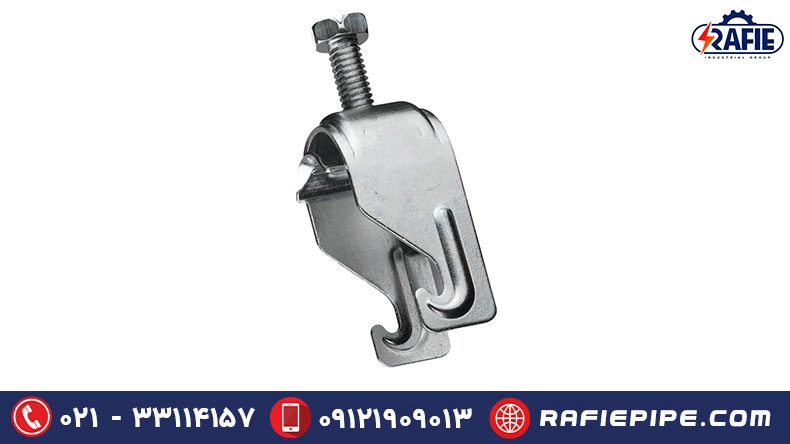
The clevis hanger, with its U-shaped geometric appearance and full compatibility with electrical conduits, plays a very important role in supporting electrical conduits and preventing them from falling at high elevations. These clamps are offered with steel material, quick installation capability, and intelligent design. Clevis hangers can easily be mounted onto C-channels, and this very feature enables their unrestricted installation. In the table below, review the technical specifications and features of the clevis hanger:
| Feature | Description |
|---|---|
| Design structure | U-shaped design that provides easy installation and strong support for pipes and cables |
| Material | Made of steel alloy or galvanized steel with high resistance to corrosion and pressure |
| Application | Used in electrical systems, industrial cabling, and installation of pipes on walls and ceilings |
| Resistance | Resistant to vibration, pressure, and harsh environmental conditions such as humidity and high temperatures |
| Easy installation | Quick and easy installation using special bolts and nuts |
| Sizing | Available in various sizes to match different types of pipes and cables |
| Stability | A strong and secure connection that increases the lifespan of cabling and piping systems |
| Adjustability | Ability to change size and adapt to various installation and project requirements |
I hope this table is helpful to you!
Adhering to a series of standards for manufacturing electrical conduit clevis hangers plays a very important role in the final proper performance and output quality. Since these clamps play a supportive role for electrical conduits and C-channels, they must definitely be made with standard material and alloy and specific dimensions. Otherwise, their stability at installation points will be compromised. Below, we highlight the most important manufacturing standards for these clamps:
As you know, there are many parts and fittings, each of which can provide a strong support system for various types of electrical conduits and cables. Among these parts is the Spit clamp. These parts can hold pipes stably in a suspended manner and increase the safety of electrical cabling and conduit installation.
But the important point is why we should use clevis hangers and what the main reason is. Regarding this important question, we must say that due to the limitations that exist in an industrial structure, many electrical conduits and also cables must be routed from the heights of the structure. In fact, cables cannot be placed scattered on the floor of the structure, nor can they be routed embedded or inside the structure.
Under such conditions, there is a possibility of damage, and most importantly, managing them will also be difficult. Therefore, clevis hangers are used so that the ceiling and wall sections can be utilized as a safe path for routing cables and pipes. In many projects, the use of metal pipe clamps allows pipes to be placed regularly and safely along ceiling and wall paths, preventing them from slipping or shifting position. Of course, for various types of cable trays and cable ladders, ceiling and wall paths are also selected along with supports and various types of brackets. Moreover, the mentioned paths increase cabling organization, work safety is enhanced, and there is no longer any concern about damage to cables and pipes.

The grip diameter of the clevis hanger indicates what size of electrical conduits and cables these clamps are capable of supporting. If the grip diameter of the clevis hanger is not taken into account, an incompatibility may arise between these clamps and the electrical conduits and cables, resulting in an incorrect connection.
Due to the adjusting lever that is usually present on clevis hangers, conditions are provided to define a size range as the grip diameter for these clamps. This size range or grip diameter is as follows:
The mentioned dimensions are all in millimeters. For example, when the grip diameter of a clevis hanger is 24 to 28 millimeters, it indicates that these clamps can support pipes and cables that are within the size range of 24 to 28 millimeters. The reason for this is due to the presence of the adjusting lever or screw on these clamps. When you fully open the screw, the grip diameter increases. Conversely, if the screw is tightened, the grip diameter of these clamps naturally decreases. With this lever, you can adjust the exact size of the pipes and cables on the clamp.
To create a strong support system for electrical cables and conduits, the clevis hanger must be mounted onto C-channel rails or clevis rails. Given the C-shaped structure of these rails, the presence of curved edges allows them to lock the clevis hangers in place. A very important point regarding the connection of the clamp onto the rails is that you can use several clamps simultaneously on a single C-channel axis.
This valuable advantage will result in the ability to support several pipes or cables at one point. To install and set up this support system, the clevis rails are first installed on the wall or ceiling surface. Then, by placing several clevis hangers along the axis of these rails, you can place the pipes and cables one after another inside these clamps. By tightening the movable lever, which is designed as a screw on the clamp, you can fix and secure the cables and pipes in place.

Clevis hangers are designed and produced in two forms: insulated clamps and non-insulated clamps. You can place the insulated types onto electrical cables. The presence of rubber insulation will ensure that no damage is caused to the cable due to the pressure force exerted by the clamp lever. On the other hand, you can use non-insulated clamps for steel pipes.
You can detach these clamps from the pipes and cables whenever you wish. For this reason, another important advantage is their quick opening and closing capability. In many electrical conduit and cabling projects, making some changes to the route of pipes and cables is naturally likely. You may want to change the conduit route or add several pipes and cables to your network. In such circumstances, you will not have a very complicated task, because the clevis hanger is easily detached from the rails, and technical modifications to the electrical cabling network are possible in any situation.
Rafi Industrial Group, as a manufacturer of various types of power cable support parts and equipment, has always been able to attract a great deal of customer satisfaction. Some of the products of this group include Spit clamps, clevis hangers, C-channel rails, couplings, and pull elbows. Each of them is designed and manufactured according to defined standards with the highest level of quality. You can contact our experts to receive pricing information as well as specialized consultation.
To receive free consultation, please fill out the form below. Rafi Industrial Group consultants will contact you as soon as possible.
To receive free consultation, please fill out the form below. Rafi Industrial Group consultants will contact you as soon as possible.