Rafi Industrial Group | Manufacturer and supplier of power cable support equipment


Proper power distribution is one of the most important concerns today for the smooth execution of large-scale commercial operations. Cable trays are among the equipment that help large industries, data rooms, factories, and buildings to easily transmit electrical wires. Cable trays are easily installed and require less technical expertise for their implementation. Rafi Industrial Group, as the best cable tray production center, enables you to manage complex wiring networks with relative ease.
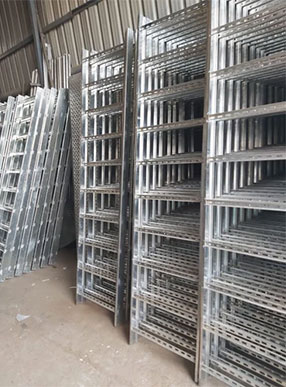
A cable tray is a standard cable support system made of hot-dip galvanized steel sheets, aluminum, and stainless steel. This structure is designed as a continuous or perforated path that routes power, telecommunications, and control cables from the main power plant or electrical panels toward consumers. According to the international standard IEC 61537, the cable tray must be able to withstand static loads, including the weight of cables and accessories, and dynamic loads caused by environmental factors such as wind or earthquakes.
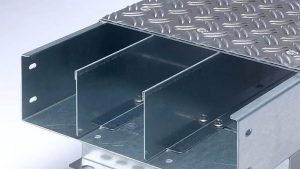
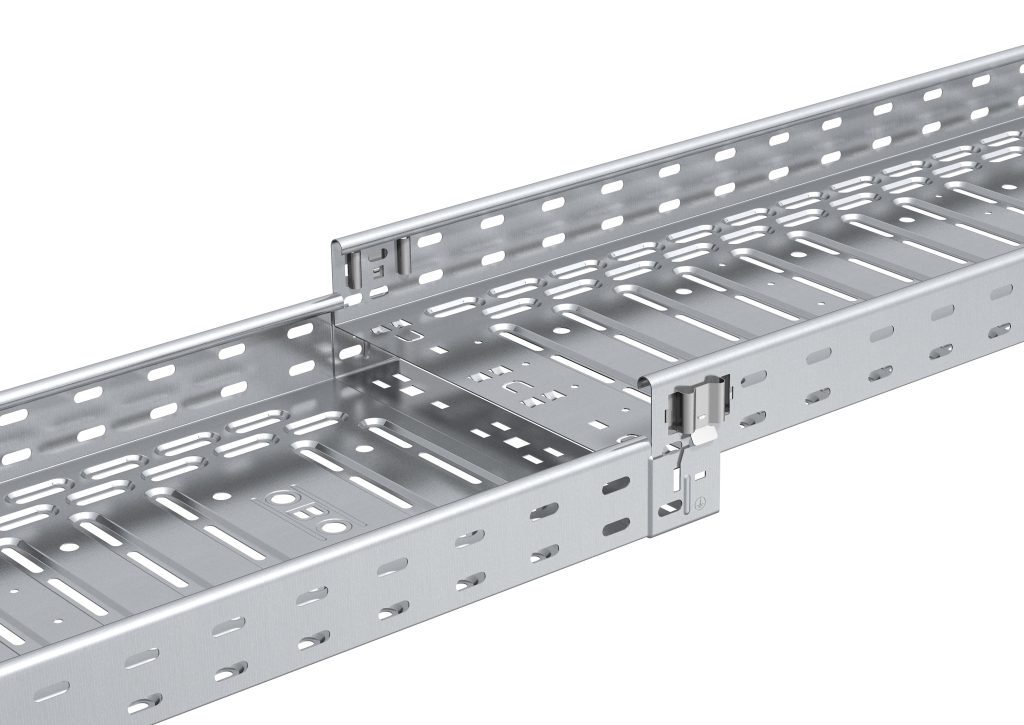
The structure of a cable tray typically includes a flat base with upward curved edges and standard holes for better ventilation. Compared to steel conduits, this system provides quick access for troubleshooting, adding new cables, and periodic maintenance without the need to dismantle the structure. The use of standard cable trays and cable tray covers in the oil, gas, petrochemical, and data center industries is beneficial due to the observance of safety distances between power and telecommunications cables and the reduction of fire risk.
Industrial environments: Safe transmission of cables in factories, power plants, and industrial refineries
Commercial and office buildings: Managing electrical and data wiring and communications in high-traffic commercial and office buildings
Hospitals and medical centers: Controlling hospital equipment cables for greater protection and safety
Oil and gas industries: High corrosion resistance in refineries and coastal platforms
Data and computer centers: Organizing cables and ensuring proper airflow for computer systems
Residential buildings: Managing multiple wires and reducing common damage in residential spaces
The right choice between cable tray and cable ladder has a great impact on the safety of wire passage and the aesthetics of the environment. Cable trays, which are manufactured by cable tray producers from integrated metal sheets, usually have slots for better ventilation. In contrast, the cable ladder, as its name suggests, has a ladder-like structure and includes side rails with specific spacing. Although both products are used for cable management, they have important differences in terms of ventilation, durability, price, and installation conditions.
Cable trays are mostly used for spaces that require greater wire stability; however, cable ladders, due to having more open space, can provide better ventilation and prevent the risk of cable overheating. Cable trays cause more moisture accumulation compared to cable ladders. Overall, cable trays provide greater protection for wires and against the entry of rodents and insects, while cable ladders are used for better ventilation in projects.
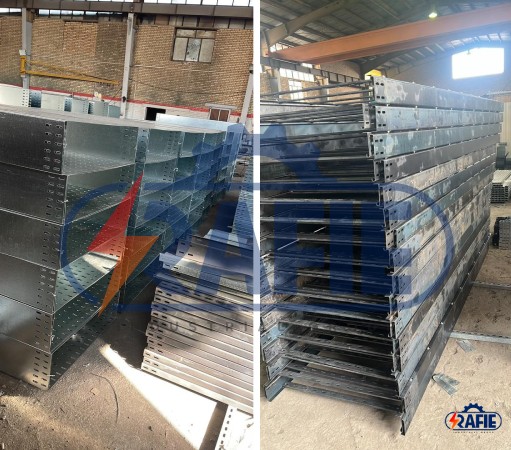
Professional and standard cable trays have precise technical specifications. These very features make the installation of cable trays possible in diverse projects with specific weather and industrial conditions.
High thickness of the steel sheet: The thickness of the steel sheet used for manufacturing these trays is selected between 1 and 3 millimeters based on the width of the tray.
Galvanized coating: A hot-dip galvanized coating with a thickness of 40 to 80 microns is usually used to increase the resistance of these cable trays.
Diverse dimensions: The width and length of cable trays are very diverse, and customers have the ability to customize them from narrow to wide widths.
High mechanical resistance: Most cable trays are capable of bearing loads between 100 and 200 kilograms per meter.
Ventilation system: Standard holes are used in these trays to prevent heat accumulation and maintain the permissible temperature of the cables.
Excellent corrosion resistance: The use of high-quality alloys and anti-rust coating increases the resistance of cable trays to corrosion and rust.
Oil, gas, and petrochemical industries: In refineries, petrochemical plants, and oil platforms for managing control cables
Power plants: For organizing high and low voltage cables in turbines, generators, and control systems
Data centers and server rooms: For centralized and organized management of network, power, and fiber optic cables, with emphasis on ventilation and easy access
High-rise commercial and office buildings: For routing power, data, telephone, and fire alarm and suppression system cables in risers and floors.
Hospitals and medical centers: Due to the need for high safety, insulation and corrosion resistance, as well as management of critical medical equipment cables.
Manufacturing and industrial factories: In production lines, robotics, and industrial automation systems for safe routing of control and power cables
Manufacturing material: Galvanized steel, stainless steel, or aluminum with a corrosion-resistant coating.
Load-bearing capacity: Different load-bearing capacity based on the type and diameter of cables.
Design type: Perforated (for ventilation) and solid (for greater protection).
Anti-corrosion coating: Hot-dip galvanized or electrostatic paint coating for resistance to environmental factors.
Production standards: In accordance with IEC, BS, UL, and DIN standards.
Resistance to temperature and environmental conditions: Resistant to various temperatures, humidity, dust, and chemicals.
Review of the installation route: Determining the appropriate route for installing the cable ladder according to the project requirements.
Surface preparation: Inspecting and preparing the surface on which the cable ladder will be installed.
Installing the supports: Installing the cable ladder supports horizontally or vertically.
Connecting the sections: Connecting the cable ladder sections using appropriate fittings.
Support and safety: Ensuring the correct and secure fixing of the cable ladder in all sections.
Routing the cables: Placing the cables on the ladder and ensuring proper organization and ventilation.
Material of the cable tray: The price of galvanized cable trays varies based on the material of the raw materials, such as steel, galvanized steel, or aluminum, and has a significant impact.
Dimensions and size: The dimensions and size of the cable tray, including length, width, and depth, affect the price. Each size has a different cost.
Type of anti-corrosion coating: Coatings such as hot-dip galvanizing or electrostatic paint increase the price of galvanized electrical trays due to additional coating costs.
Load-bearing capacity: A cable tray with a higher load-bearing capacity is usually more expensive, as it requires stronger materials and a more complex design.
Design type: Perforated or solid cable tray design can have a direct impact on costs, as the production process differs.
Order quantity: Bulk orders usually have a lower price because production costs are relatively reduced and more discounts are offered.

Material and quality of raw materials: When purchasing cable trays, pay attention to the material, such as galvanized steel or aluminum, to ensure durability and corrosion resistance.
Load-bearing capacity of the cable tray: The load-bearing capacity of the cable tray is determined based on the number and thickness of the cables. Choosing a tray with an appropriate capacity is essential to prevent damage to the cables.
Appropriate size and dimensions: The size and dimensions of the cable tray must be appropriate to the project space and the number of cables to prevent clutter and disruption in the electrical flow.
Anti-corrosion coating: Examining the anti-rust coating, such as galvanized or electrostatic paint, of the cable tray is very important for use in humid and industrial environments.
Specialized consultation in the purchase and installation of cable trays for your projects, aimed at providing optimal and safe solutions. Our team is ready to provide the best choices for your facilities.
To receive free consultation, please fill out the form below. Rafi Industrial Group consultants will contact you as soon as possible.
To receive free consultation, please fill out the form below. Rafi Industrial Group consultants will contact you as soon as possible.