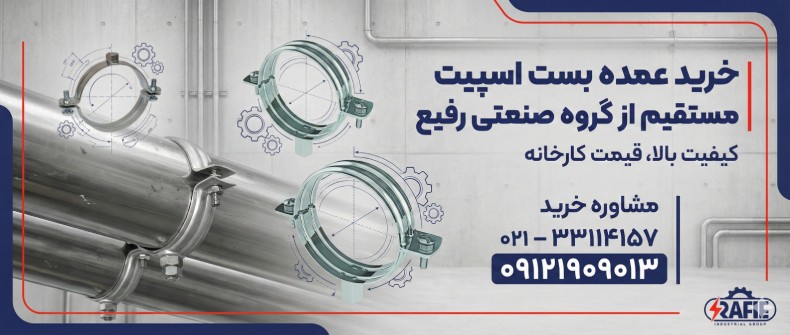
When electrical conduits need to be installed at heights, the conduits must necessarily remain suspended adjacent to the ceiling. In this situation, which part is responsible for holding the conduits in a suspended manner? The Spit clamp is exactly the part that, with easy operation, very high safety, and direct connection to the ceiling, keeps the conduits near the ceiling and prevents them from falling. These clamps are shaped like a circle with various diameters, which you can obtain and implement based on project requirements from Rafi Industrial Group.
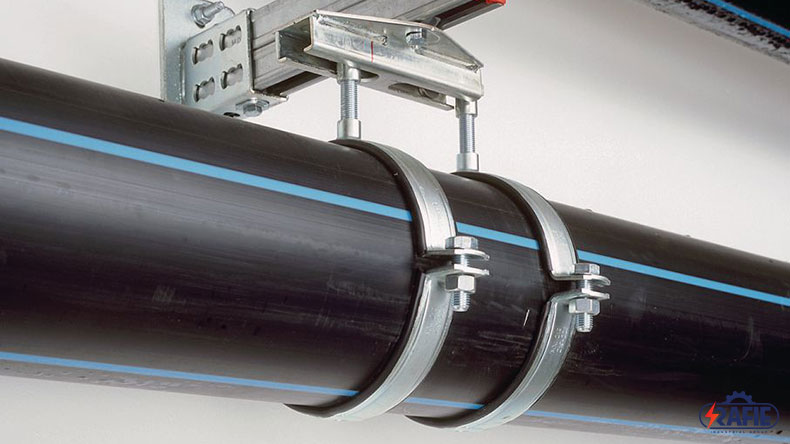
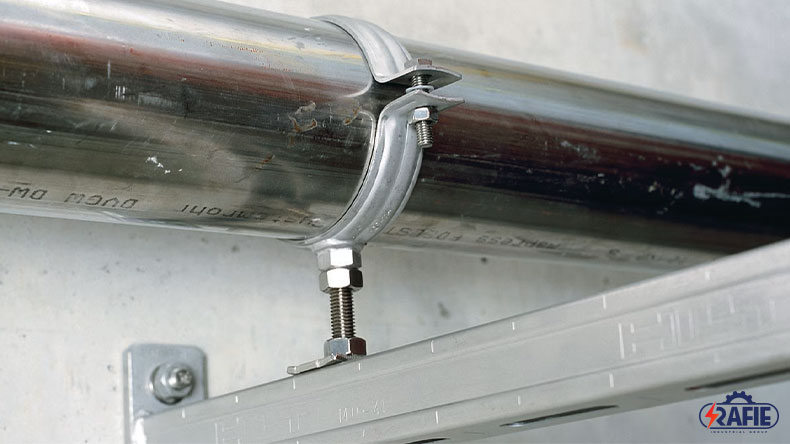
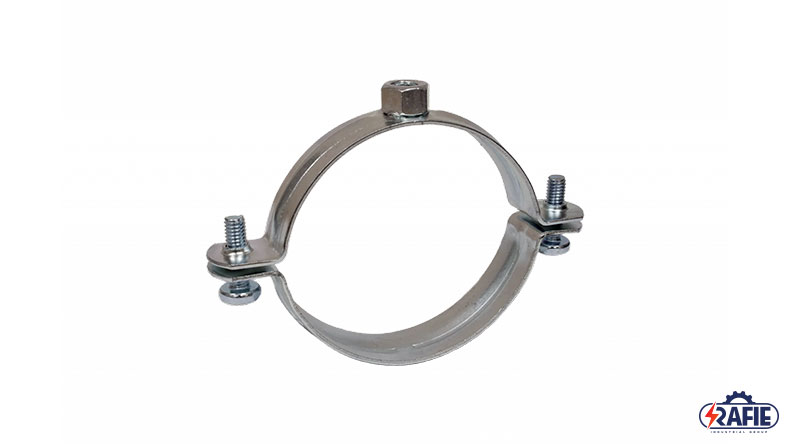
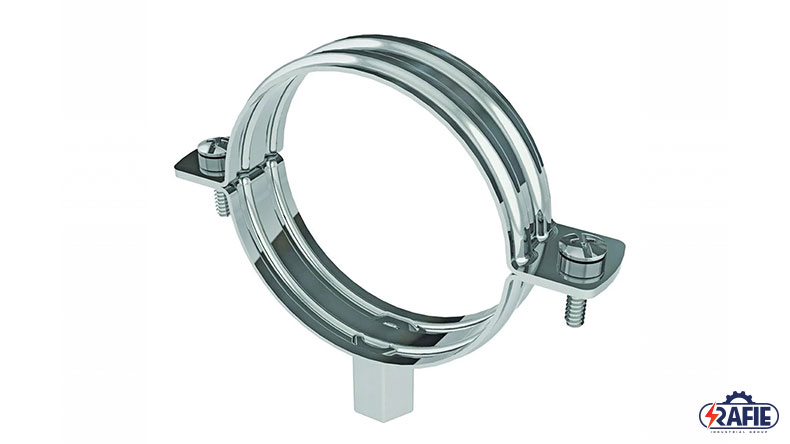
A Spit clamp is a type of fitting or holder used in the construction and building services industry for securing small to medium-sized electrical conduits. These clamps are usually made of metal or durable plastic, and with their specific design, they enable quick, firm, and safe installation of equipment. Their structure is in the shape of a circle that is placed around the electrical conduit with two screws, holding it fixed in place at a suitable height.
Features of Spit Clamps
The Spit clamp, with its special design, high strength, and proper performance, enables the implementation of the most complex electrical conduit networks with excellent support. With this clamp, there is no need for welding or heavy connections. Especially if the hot-dip galvanized model of this product is chosen, its resistance to moisture is very high and it has good compatibility in terms of size and material with electrical conduits. Among the most important features of this clamp are the following:
Excellent compatibility with electrical conduits: The shape of the Spit clamp is circular and is geometrically compatible with electrical conduits. Also, due to being made of galvanized steel, these clamps can perform excellently and in harmony with the electrical conduit.
Quick opening and closing: Because the Spit clamp is two-piece, opening and closing it is possible quickly and with only a screwdriver. Therefore, if for any reason you need to change direction or reposition the clamp and conduits, you can easily open the clamp and reuse it.
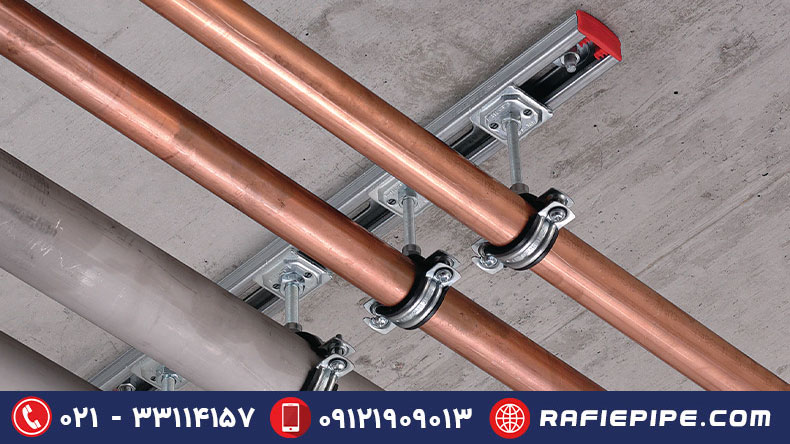
Has galvanized rod: The upper part of the Spit clamp has galvanized rods that allow suspended connection to the ceiling. Moreover, the galvanized rods in these clamps change with the size of the Spit clamp itself and have different dimensions.
International standards: The Spit clamp, the connecting bolts and nuts on both sides of the clamp, and even the predefined installation method of Spit clamps are based on international standards.
Has insulating coating: Some Spit clamps, in addition to being made of resistant galvanized steel, also have an insulating coating that prevents the passage of electrical current.
Resistant material: Spit clamps are designed to support steel electrical conduits. Therefore, they are made of resistant galvanized steel with minimal flexibility to perform well even in special conditions.
Introduction to Types of Spit Clamps for Industries
The main task of this type of clamp is to suspend electrical conduits and prevent them from falling. In terms of appearance, all clamps have a pipe-like structure in which the conduit is placed, and a part of the clamp is also connected to the ceiling. However, in terms of installation method, Spit clamps can be divided into two groups: single-sided and double-sided clamps.
Single-Sided Spit Clamp
This type of clamp is designed to open from only one side. In fact, whenever the clamp needs to be installed on the conduit, it is enough to open its screw and, by opening the clamp, place the conduit inside it. These types of clamps have high flexibility, but their stability and strength are not acceptable. Nevertheless, if quick installation of the clamp for electrical conduits is required, this product provides a faster option. In fact, it saves the time of tightening one screw during the installation of each clamp.
Double-Sided Spit Clamp
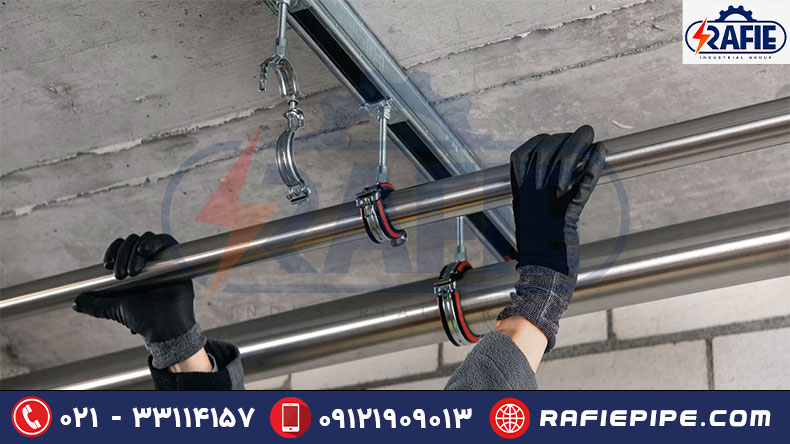
This type of clamp is recognized as the most durable and most common type of clamp available in the market. There are two screws on both sides of the clamp; by opening them, you can place the conduit inside one half-circle and install the other half-circle on top of the conduit. Finally, by tightening the two screws, the clamp is secured and holds the conduit in place. The strength and durability of this type of clamp is much higher than single-sided clamps; however, you need to spend a little more time installing double-sided clamps.
Ideal Resistance of Spit Clamps Against External Forces
Because the Spit clamp locks well in its place, it can have very suitable resistance against external forces. Moreover, like the electrical conduit, this product is also made of steel. This feature is especially true for double-sided Spit clamps, which are tightened in place with screws. Spit clamps have suitable resistance against external forces such as vibration, shaking, and impacts. Therefore, even in high-traffic environments and sensitive automotive and construction industries, this type of clamp can be used with full confidence, without worry about the electrical conduits coming out of their designated path.
Spit Clamp Price List for Electrical Conduits
Since the price of each electrical conduit fitting is influential in customers’ choices, it is recommended that you inquire about the price before starting to plan for the purchase and installation of Spit clamps and electrical conduits. Spit clamps are usually made of steel. Therefore, the first factor affecting the price of these clamps is the daily dollar and currency rate. The second factor is the size of these clamps, which is determined based on the type of conduit you intend to install. Overall, the clamp structure, material, additives used (such as insulating rubber), and other details can affect the cost of Spit clamps. To inquire about the current price of these clamps, you can get in touch with Rafi Industrial Group right now.
How Is a Spit Clamp Installed?
The correct installation of a Spit clamp plays a very important role in its performance and durability. Therefore, it is essential that this task is entrusted to experienced technicians and carried out with specific principles. Additionally, the distance between Spit clamps must be observed to fully support the electrical conduit. Below, we review the steps:
First, the galvanized rod or C-channel must be installed in the designated location. After installing these parts, ensure their strength and durability.
Connect the Spit clamp to the C-channel or galvanized rod.
Open the two screws of the Spit clamp and place the conduit in the middle section of the clamp. Pay attention that the clamp must cover around the conduit without any looseness.
Now tighten the screws of the Spit clamp on both sides and fasten them with a suitable wrench until the conduit is fixed.
The standard distance between Spit clamps must be observed. Typically, the distance between these clamps for electrical conduits is 1.5 to 2 meters, which in this case provides good support for the electrical conduits. After completing the Spit clamp installation process, you must ensure the conduit is level, properly positioned, and fully supported.
Is It Absolutely Necessary to Use a Galvanized Rod for Installing Spit Clamps?
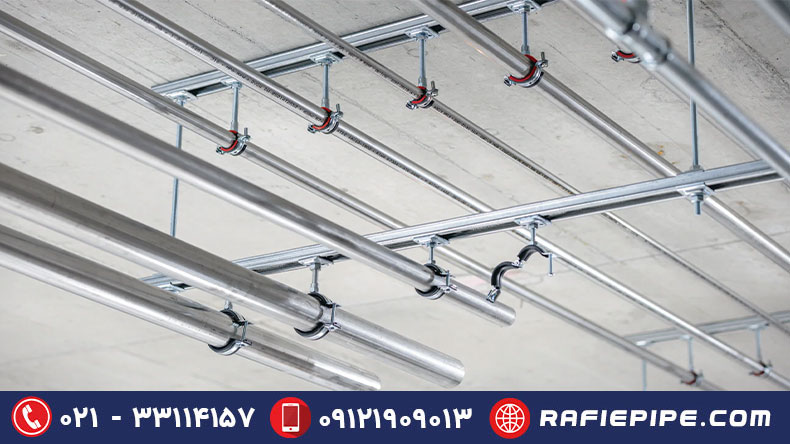
If you look at various images of electrical conduit projects, you will usually see a galvanized rod or threaded rod hanging downward from inside a C-channel, especially at heights within the structure in the ceiling area. At its end, there is a Spit clamp that surrounds the conduit.
Do you think that, apart from using a galvanized rod or threaded rod, there is another part that can act as a link between Spit clamps and C-channels? There is definitely no such part. Therefore, threaded rods must be used for connecting and implementing Spit clamps, and there is no alternative part for it.
Do Spit Clamps Always Create a Suspended Support System?
In all cases, no. That is, Spit clamps do not always provide a suspended support system. Rather, they may also provide conduit support conditions in a reversed manner. To do this, it is only necessary to use a C-channel on the wall or profile area. After that, the conduits can be stabilized from the top of these same profiles using rods and Spit clamps in a reversed fashion.
This valuable feature of Spit clamps will enable you to create a professional and relatively complex conduit network. So, a Spit clamp can keep steel electrical conduits stable both from top to bottom and from bottom to top. Which support system is used depends on the conduit route and their installation location, and a single connection system cannot be used in all projects.
What Are Other Applications of Spit Clamps in Industry?
Based on the explanations provided in this article, many people may think that Spit clamps, in insulated models or non-insulated versions, were only designed to support galvanized electrical conduits. But this is absolutely not the case. In the piping industry, when conduits need to be routed and directed at heights, these clamps are used. It does not matter whether the intended conduit is for supporting electrical cables or if you want to use them for transmitting water and electricity fluids.
Currently, in many industrial piping networks, gas pipes may pass at heights. The same features apply to water pipes. Therefore, it is necessary to use much more resistant types of Spit clamps to both bear the weight of the pipes and prevent them from falling due to vibration and similar stresses.
Spit Clamp or Regular Pipe Clamp? Which Is Better?
The choice between a Spit clamp and a regular pipe clamp depends on the type of project and the required level of strength. The Spit clamp, due to its double-sided design and the presence of two tightening screws, has greater holding power and is more suitable for installing heavy steel conduits in electrical and industrial facilities. This clamp is installed on a galvanized rod or C-channel and has higher resistance to vibration, displacement, and corrosion.
In contrast, a regular pipe clamp has a simpler structure and is mostly used for lightweight pipes or temporary installations. This type of clamp offers faster installation, but in large projects or humid and industrial environments, it will have less durability and strength compared to a Spit clamp.
If you are looking for durability, safety, and high load-bearing capacity, the Spit clamp is the better option.
If you have a lightweight, low-budget project, a regular clamp will suffice.
Structural Specifications of the Spit Clamp
The Spit clamp is designed and structured in such a way that it can completely surround the pipe. On both sides of this clamp, there are two screws that connect the two crescent-shaped parts of the clamp together. It is made of galvanized steel sheet, which is reinforced with a hot-dip galvanized coating.
This coating is used to protect the part and prevent rust and corrosion. Spit clamps are generally designed and manufactured in two types: insulated and non-insulated, each used for specific projects.
Spit Clamp for Electrical Conduit; The Best Connector in a Suspended State
The Spit clamp is one of the main components for keeping conduits stable. But what is important is that these clamps have the capability to create a support or suspended support system. That is, conduits can be supported by metal Spit clamps from the ceiling and even walls. A valuable feature of these clamps is that through galvanized rods, which are known as very long threaded rods, it is possible for conduits to be supported from the ceiling section of the structure.
Since galvanized rods, as threaded steel rods, can be cut, different heights can easily be created for the suspended system. This means that from the ceiling section of the structure, lengths of 100 cm, 50 cm, and 30 cm can be cut for galvanized rods so that conduits can be held suspended at various heights.
This capability is considered a very important and fundamental advantage in itself. A suspended system or support cannot be provided for electrical conduits with other connecting parts. The Spit clamp has such a practical feature solely because it can be screwed onto galvanized rods. Furthermore, the metal Spit clamp has various designs that make its use more extensive.
Similarities and Differences Between Spit Clamps and Clevis Hangers
In terms of usage type and other features, Spit clamps share a number of similarities and differences with various types of clevis hangers. In fact, we need to know which of these clamps to use for our project and what features each one has. If we want to examine the similar elements of these two clamps, it is that the material of both is galvanized steel sheets.
On the other hand, both of these parts can be used to support electrical conduits. Clevis hangers have a wider application, and their insulated versions are designed for supporting electrical cables. However, Spit clamps are functional for electrical conduits and other pipes. Spit clamps and clevis hangers must definitely be used with C-channels for installation in the structure. Spit connections are suspended via galvanized rods. But the clevis hanger is placed inside the C-channel rail as a rail clamp.
This is a functional difference or distinction between these clamps. Polymeric insulators are also used for clevis hangers and Spit clamps to increase connection safety by creating a relatively soft texture. For Spit clamps, these insulators will prevent the conduit from slipping. But a clevis hanger needs insulation when you want to use them for securing cables.
Whatever type of cabling and electrical conduit network you intend to build, these two types of fittings are undoubtedly necessary and essential. But the architecture of the network determines the selection of these connecting parts. Therefore, the quantity and location of use cannot be considered the same for all projects.
Making the Right Choice for Pipe Clamps
When you want to build an electrical conduit network, you must know what fittings are needed for your project. Since pipe fittings and even cable connecting parts have a very high variety, each is used in its appropriate position and point. With the precise knowledge we have of pipe clamps, we can make a correct choice. Spit clamps, clevis hangers, U-bolt clamps, base-mounted pipe clamps, and other types are each selected based on the route of the conduits and cables.
Here, it is the structure plan that determines which of these clamps you should choose. The advantages that can be mentioned for correctly identifying the appropriate clamp are, first and foremost, cabling safety and the stability of the conduits at the heights of the structure. Something that no industrial manager wants to happen is, in fact, structural collapse and incurring high costs for repair and maintenance. To ensure such an important matter, alongside selecting quality conduits, clamps must also be used and chosen based on the size of the conduits.
Why Is the Installation and Connection of Spit Clamps a Top Priority?
When the subject of installing and connecting parts in a power cable support network arises, special attention must be paid to employing professional work teams. Imagine you have a set of very strong clamps with a robust steel structure. Do you think the firmness and stability of these clamps alone can keep the conduits in place at heights? Certainly, this will not happen on its own. That is, Spit clamps will have ideal performance when they are installed in a principled manner together with their complementary parts, which include galvanized rods and C-channels, at the high elevations of the structure.
The matter of installing and connecting Spit clamps is so important that it may be mentioned several times in a technical and specialized article. The repetition of this subject indicates that part of your capital should be spent on the standard installation of these items. Usually, companies and organizations responsible for the production or sale of these parts can introduce experienced execution technicians to employers to carry out the installation operations, so that you can witness the completion of your project within a specified timeframe.
Spit Clamps Are Made for Supporting Pipes, Not Cables
In all projects where pipes and piping networks are needed to support electrical cables, Spit clamps will typically be used to create suspended supports. That is, there must definitely be a pipe and pipe branches in the network in order to mount the clamps on them. So, if you want to use thick cables without pipes, you should know that these clamps cannot hold the cables on their own.
This is because electrical cables, whatever their size, are somewhat flexible. Therefore, routing them without pipes can cause them to sag or structurally deviate. So, to carry cables in a suspended manner, either pipes or trays and ladders must be used, or if the cables are routed along wall paths, clevis hangers may replace Spit clamps. These are specialized points that many executive teams are aware of when selecting connecting parts and equipment. Of course, pipe clamps are much more diverse than cable clamps, because cables are usually routed inside pipes.
Various Sizes of Spit Clamps
As mentioned, electrical conduits come in various sizes. Each is selected and used in projects according to the dimensions and diameter of the cable. Consequently, Spit clamps are also classified in various sizes. The dimensions of these clamps are as follows:
Pg11
Pg13.5
Pg16
Pg21
Pg29
Pg36
Pg48
To choose the correct size for these clamps, it is better to have a precise assessment of your project; what size of pipes you are using, and the required number of clamps to keep the pipes stable.
How to Connect Spit Clamps in a Suspended Manner
Typically, the connection of various Spit clamp sizes is ceiling-mounted. To establish this connection, a series of complementary parts must also be used. C-channels are one of these parts. You can connect Spit clamps directly to the channels using threaded galvanized rods to hold electrical conduits.
You can have multiple Spit clamp connections per unit length of each C-channel. What is important in electrical conduit installation and connection projects is being able to attach the C-channels to the ceiling area in a completely standard manner. In fact, the main load of the electrical conduits, after the Spit clamps, is transferred to the installation point of the C-channels. This is why we always emphasize making the installation of channels to the ceiling a priority in your project.
Very High Strength of These Clamps
Although the Spit clamp is made of galvanized steel sheets in a small thickness, due to the high density of the metal type and alloy used in the manufacture of these parts, they always have high strength. These parts can bear the heavy weight of various types of steel electrical conduits. Of course, their installation intervals along a steel conduit are also extremely important.
It may be necessary to use two or three Spit clamps on a 3-meter length of steel electrical conduit. The stability of a cabling system using various types of electrical conduits, clamps, and C-channels depends on the strength and rigidity of the connecting parts, and most importantly, on the method of their installation and setup.
High quality of parts does not always guarantee the stability of an electrical cabling project. You must also observe the highest defined standards in the field of installation in order to have a safe, organized, and ideal network.
The Possibility of Suspended Routing of Steel Conduits Using Spit Clamps
In many electrical cabling and conduit networks, selecting the appropriate routes is highly important — being able to choose paths that maintain the safety of the cabling network while also preventing damage to work environments and industrial spaces.
Choosing suspended routes from the ceiling area is one of the ways electrical cables can be routed using various types of clamps and steel conduits. In suspended ceiling routes, environmental stresses cannot have a destructive effect on the cabling path. Access to these conduits, given their significant distance from the floor level of the structure, will be very difficult. This is why, in addition to installing electrical conduits on walls and ceilings, various types of cable trays — which are also accompanied by cable tray clamps — are used in a suspended manner for routing cables.
The main objectives in a cabling network are maintaining safety and keeping cables away from environmental stresses. The use of electrical conduits and their other fittings, such as Spit clamps, is precisely for this same purpose.
Other Types of Electrical Conduit Fittings
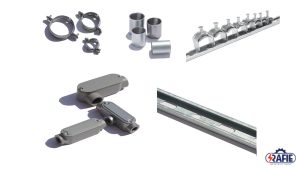
To have a cohesive and completely stable cabling network, it is necessary to use a series of fittings such as Spit clamps, clevis hangers, and other conduit fittings like couplings, pull elbows, and pull tees. In general, cabling network fittings are classified into two categories: structural fittings and conduit fittings.
Structural connecting parts mainly include C-channel rails or clevis rails, galvanized rods, two-base wall clamps, and other common structural fittings. Parts responsible for connecting two electrical conduits to each other are among the other components used to create the conduit network.
Rafi Industrial Group | Representative for Production and Sale of Spit Clamps for Electrical Conduits 🎯
Rafi Industrial Group, as one of the reputable manufacturers of building services equipment, produces Spit clamps using high-quality galvanized steel sheets and in accordance with modern standards. Utilizing advanced machinery, this group offers clamps with precise dimensions, high mechanical strength, and anti-rust coating, suitable for construction, industrial, and urban infrastructure projects.
In addition to production, the wholesale of Spit clamps in various sizes and thicknesses is carried out by Rafi Industrial Group so that contractors and building services companies can meet their project needs with the best price and quality. Fast nationwide shipping, specialized consultation, and quality assurance are among the advantages of wholesale purchasing of this product from Rafi Industrial Group.