Rafi Industrial Group | Manufacturer and supplier of power cable support equipment


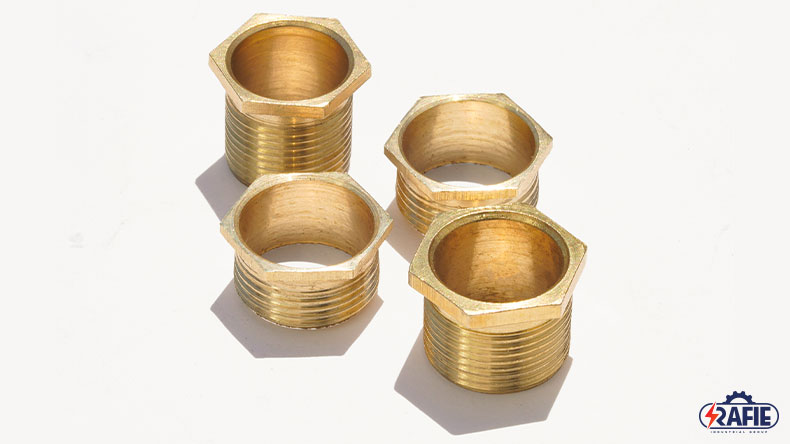
Small parts such as the brass bushing play a very important role in creating safe and high-quality conduit installations. This part, in the form of a simple ring but with a very important function, enables the connection of various types of steel electrical conduits to junction boxes and electrical panels, so that cables can be used in the appropriate place without worry about damage, impact, or tearing at the connection point of the conduit to the panel and junction box. By purchasing high-quality metal brass bushings, there is no longer any need to worry about damaging the wire sheathing, and the safety and efficiency of the wires are maintained in the best possible way.
A brass bushing is one of the important parts for connecting electrical conduits, usually made of metal, especially galvanized steel. Brass bushings are ring-shaped, and their main function is to connect the electrical conduit to a junction box or electrical panel. Simply put, whenever the end of a flexible conduit or steel conduit needs to be connected to another box, a brass bushing must be used so that the conduit is firmly fixed in place and does not detach due to tension and vibration.
The brass bushing is a metal part made of brass, designed with a wrench head and external threading so that several steel electrical conduits can be connected to each other in a straight path. These parts are manufactured with high density, standard dimensions, and full compatibility with electrical conduits. Among the most important technical specifications of these parts are the following:
Alloy material: The most important technical characteristic of the brass bushing is its brass material. These parts are made of resistant brass alloy and demonstrate good resistance to rust and moisture.
High density: The density of the brass alloy used in the brass bushing is very high to provide greater stability for heavy electrical conduits such as steel electrical conduits.
Thread location: The thread location on brass bushings is on the outside. One side of the brass bushing is designed with threads, and the other side is plain, which enables connection to the electrical conduit.
Standard dimensions: The sizing of brass bushings is very diverse and is considered standard. In accordance with the PG standard, it can be obtained in dimensions 11, 13.5, 16, 21, 29, 36, and 48.
Compatibility with electrical conduits: The size of brass bushings is compatible with electrical conduits. Therefore, when purchasing, you must match the dimensions of these conduits with the bushings.
Wrench head: Unlike ordinary couplings, brass bushings are designed with a wrench head, and for the precise and firm installation of these parts, you must definitely use a wrench of the appropriate size.
The correct installation of a brass bushing is a very simple process, but if you do not observe safety precautions and a series of principles, this process will become more difficult for you. First, you must match the size of the brass bushing with the steel electrical conduit. After that, using a special wrench, carry out the installation process while observing the following points.
Size compatibility: The size of the brass bushing must be compatible with the steel electrical conduit, panel, and junction box. Before installation, be sure to ensure that this part fits inside the punch of the electrical panel or junction box and provides the necessary resistance.
Installing lock nuts: During the installation of the brass bushing, lock nuts must definitely be used to secure the brass bushing in place.
Connecting a plain coupling to the brass bushing: If the electrical conduits have external threads and it is not possible to connect them to the brass bushing, a safe connection for the junction box can be created by connecting a plain steel coupling to the brass bushing.
Safe wrench tightening: By turning the brass bushing, it can be inserted into the junction box and connected to the conduit so that its hexagonal edge attaches to the box. Be sure to perform the wrench tightening safely and precisely, but do not apply excessive pressure.
Final inspection: Finally, after tightening the brass bushing, ensure that the cables inside the electrical conduits pass through the brass bushing easily and there are no sharp or cutting edges for them. Also, ensure that there is no looseness or play in these connections.

Every part in the industry has its own specific function. The brass bushing is no exception to this rule and has its own specific details. The brass bushing essentially acts as a connecting base whose function is to connect various types of electrical conduits to each other. This part is often overlooked and can play a fundamental role in ensuring the integrity and efficiency of electrical networks in a building.
Therefore, this part can be recognized as an efficient component for creating safe connections. This product can be used not only between various conduits but also between other vital components such as junction boxes and pull boxes. Among the most important applications of brass bushings in industries, the following can be mentioned.
Oil, gas, and petrochemical industries: This part is used to connect various pipes to each other and reduce the wear of moving parts in the oil, gas, and petrochemical industries. In the petrochemical industries, due to its high resistance to corrosion and heat, this part can also be used as a stabilizer and connector.
Automotive industries: This part, which has high resistance to corrosion and heat, can be used for manufacturing industrial machinery and automotive production. This product is also used to increase the service life of various parts in these vehicles.
Transmission of electrical wires and cables: Due to its resistant and highly protective features when connecting two pipes together, this type of part can be used to protect wires and cables against threats from vermin. Because these parts can create strong connections, they also contribute to the overall lifespan of the electrical system and help prevent short circuits by blocking moisture ingress.
Coupling electrical conduits is one of the vital stages in the installation and connection of electrical conduits, which plays an important role in the safety and stability of power distribution systems. For the correct execution of this task, the use of standard equipment and the observance of technical points are essential. In this context, reading the electrical conduit coupling buying guide can help you choose a product of appropriate quality and suited to the needs of your project. Considering the type of conduit, diameter, and material of the coupling, the correct selection results in tight and leak-free connections and increases the service life of the system. Therefore, simultaneously with carrying out the electrical conduit coupling operation, utilizing the electrical conduit coupling buying guide will be a guarantee for a professional and safe installation.
As is clear from the name brass bushing, it means a bushing made of brass. Its material of manufacture is entirely brass. Although this type of metal ranks after steel and stainless steel materials in terms of structural resistance and hardness, given their suitable density, they can maintain the safety of connections. A very wide range of sizes of this product is designed and manufactured, which includes PG11, PG13.5, PG16, PG21, PG29, PG36, and PG48.
This variety of sizes naturally provides the conditions for all steel electrical conduits to have full conformity and compatibility with this type of connector. An important point to consider when purchasing these products is to match the size of the brass bushing with the dimensions of your steel electrical conduit so that they have precisely the capability of installation in the conduit network.

In order to use brass bushings completely correctly, we must first fully understand these parts and their other components. Typically, a brass bushing also has a separate nut called a lock nut, and these two parts are usually used together. Steel electrical conduits cannot be placed freely inside an electrical panel or metal box, because they will come out with the slightest force.
Therefore, we must fit or lock these conduits inside these boxes. Steel couplings, which are used to connect conduit branches to each other to increase their size and length, will be installed on the ends of the threaded conduits. These conduits, near the boxes, must again be screwed onto another secondary part. Given the explanations mentioned about the structure of brass bushings, they have a threaded base.
This base is guided from the inside of the electrical box through the box hole towards the outside. Therefore, the wrench-head or hexagonal part of the brass bushing is inside the box, and its base is outside the box. This base is threaded on the outside, meaning it can easily be screwed onto the steel conduit couplings. Of course, you must keep in mind that to fully fit the brass bushings, lock nuts are screwed onto them from the outside so that the brass bushings do not have any movement.
After installing the lock nut, you can screw the steel couplings onto the base of the brass bushing. This type of installation will be repeated for other conduit-to-box connections. Any type of box used with conduits must have the electrical conduits fitted and secured in it, so we need a brass bushing. Of course, there are also other types of single-screw and double-screw glands that can connect conduits to these boxes.
During the installation of a brass bushing to other electrical boxes, several elements must be taken into consideration. When you want to guide the bushings from the punched inner part of panels and metal boxes outward, you must check whether the base size of the bushing is compatible with the diameter of the holes in the electrical panel. Therefore, we must ensure dimensional coordination between these two. Be careful not to forget the lock nuts during the work. These parts are responsible for fixing and firmly holding the brass bushings in place. In many cases, steel couplings may be directly screwed onto the base of the brass bushing.
In such cases, some looseness or play may occur after completing the connections. The brass bushing is completely rustproof, but if you have a very highly corrosive environment, you can also use stainless steel types and even galvanized models.
These connecting parts are cylindrical in shape, with one end having a hexagonal shape or wrench area. The base of the brass bushing is fully threaded on the outside. This type of structure will allow you to easily screw these connecting parts onto the steel electrical conduit coupling. The structural features of these connecting parts are such that they do not fracture or undergo structural deterioration under tensile forces, so they can resist impact and other environmental stresses up to a certain limit.
The most important point about these parts is their rustproof nature. Brass material is inherently rust and corrosion resistant, so they can easily be used in humid environments, and chemical processes such as oxidation cannot affect their structure.
When steel electrical conduits are placed inside panels and metal boxes, they must remain in place completely stable and fixed. Generally, without using a brass bushing, this stability cannot be achieved. Consequently, these connecting parts are among the most vital elements in the electrical conduit installation process.

Regarding the structural variety of brass bushings, usually two types of these products are designed and manufactured. These two types include the short-base brass bushing and the long-base brass bushing. The length and size of short-base types are usually 15 millimeters, and connecting parts with a long base have a length of 20 millimeters. Each of these is used according to the structure of the electrical panels.
Brass bushings, which are entirely made of brass metal, have a very high manufacturing quality. However, some of their types may be strengthened with nickel coatings, in which case their chemical resistance to corrosion will be doubled.
By using brass bushings, you can prevent the possible dislodgement of steel electrical conduits from various types of switch boxes and electrical panels.
Due to the structure of these parts, the opening and closing process is practically carried out more quickly, and you can more easily mount these parts onto steel electrical conduits and other fittings.
The wide range of their sizing will allow various steel conduits to be connectable to these parts.
High manufacturing quality, resistance, and body strength are among the main advantages of brass bushings.
As you know, ensuring safety at the location of electrical cable connections is extremely important. When you guide electrical cables through steel conduits into panels and switch boxes, they must not be exposed to tensile force or any other type of stress. The electrical cables inside the panels are connected to a set of terminals, and any detachment of these cables from the terminal location can cause the risk of fire or even explosion in various industrial environments.
For this reason, to prevent the steel conduit and, consequently, the electrical cables from coming out of their place, they are kept inside the panel using brass bushing connecting parts. It can be said that the last part placed as a connector onto the couplings and thereafter onto the steel conduit is precisely these brass fittings.
At Rafi Industrial Group, a wide range of electrical conduit fittings such as pull elbows, pull tees, conduit bodies, and couplings are manufactured with the highest level of quality. The design type of these parts complies with internationally defined standards, so the safety of electrical cabling and conduit networks will be multiplied using these parts. Dear customers can contact our experts to receive pricing information as well as obtain specialized consultation.
To receive free consultation, please fill out the form below. Rafi Industrial Group consultants will contact you as soon as possible.
To receive free consultation, please fill out the form below. Rafi Industrial Group consultants will contact you as soon as possible.
![Flexible cable gland for flexible conduit [Best price + Wholesale sale]](https://rafiepipe.com/wp-content/uploads/2022/10/گلند-کابل-فلکسیبل-300x169.jpg)

